
Power Mapping Economic Mobility
- Mar 31
- 5 min read
Updated: Jul 9
Why programs alone don’t change outcomes, and how understanding power can

Efforts to improve economic mobility are often measured by what is built. New training programs. Expanded services. Increased participation. And yet, for all this activity, outcomes do not always improve at the same scale. This is not a failure of effort.
It is often a failure of perspective. Because economic mobility is not shaped by programs alone. It is shaped by systems and by the people and institutions that hold influence within them.
To change outcomes, we have to understand how those systems actually work.
From Influence to Power Mapping
The idea that power shapes outcomes is not new.
In the 1950s, sociologists like Floyd Hunter and C. Wright Mills studied what they called “power structures,” the networks of individuals and institutions that influence decisions within communities and across society. Their work revealed a simple but important truth: formal authority does not always reflect where real influence sits.
Later, organizers such as Saul Alinsky translated these ideas into practice. Alinsky, a community organizer based in Chicago, focused on how everyday people could build collective power to influence decision-making. His work emphasized that understanding relationships and influence was essential to creating change.
But the concept of power mapping as a structured tool, something you can systematically apply, was developed more explicitly by Anthony Thigpen of SCOPE in Los Angeles. Thigpen’s approach gave practitioners a way to identify who holds decision-making authority, understand who influences those decision-makers, map relationships across institutions, and develop strategies to shift outcomes.
Today, power mapping is used across fields, from community organizing to corporate strategy, because it offers something simple and powerful:
A way to see what is usually invisible.
Why This Matters for Economic Mobility
Most workforce strategies start in the same place.
They focus on programs. Training people for in-demand jobs. Connecting participants to employers. Expanding access to education and services.
This work matters. But on its own, it is not enough.
Because workforce systems do not operate in isolation.
Outcomes are shaped by a broader set of forces: employer hiring practices, industry demand, public policy and funding, access to education and credentialing, and the support systems that help people persist.
When these elements are not aligned, programs can succeed in participation while falling short on long-term outcomes.
This is where the conversation often gets oversimplified.
Workforce development is sometimes framed as a choice between pathways: four-year degrees or alternative routes like certifications and apprenticeships.
But this is not an either-or decision.
A strong workforce system creates access to both. It ensures that individuals can pursue a college degree if that is the right path, and also that they are aware of and able to access other career pathways that lead to stable, well-paying jobs.
Because for many families, the barrier is not just cost or skill.
It is visibility.
Entire career pathways exist that people are simply never exposed to, and therefore never pursue. In that sense, workforce development is not just about training.
It is about expanding awareness, access, and alignment across the system.
Looking at Workforce Systems Differently

If we shift the focus from programs to systems, a different picture begins to emerge.
Economic mobility is shaped by the interaction of multiple actors.
Government and policy set the rules, funding, and incentives. Employers determine hiring practices, wages, and advancement opportunities. Education and workforce agencies build skills and credentials. Community organizations provide the support that helps individuals persist and succeed. Each of these plays a role. But they do not operate equally.
Some decisions carry more weight than others. Some actors have greater influence over outcomes.
This is where power mapping becomes essential.
What Power Mapping Reveals

Power mapping shifts the central question.
Instead of asking what programs are we building, it asks who needs to act differently for this to work.
That shift matters. Because it directs attention to the people and institutions that shape outcomes:
Which employers are driving hiring trends?
Which policies influence incentives and funding flows?
Which organizations shape access to information and opportunity?
How are these actors connected to one another?
It also reveals something just as important. Not all influence is formal. Some individuals and organizations hold power because of their position. Others hold power because of their relationships, credibility, or ability to shape decisions behind the scenes. Understanding both is critical. When power is understood and aligned, the system itself begins to shift.
Looking at Workforce Development Through a Systems Lens
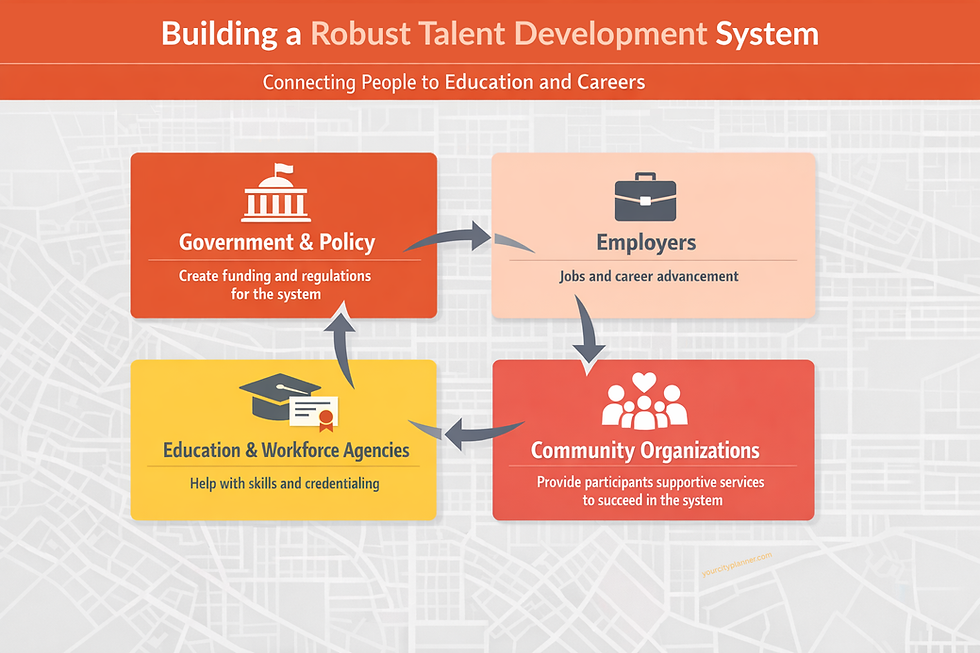
Most workforce strategies are designed around programs.
They focus on what can be built, delivered, and scaled. Training cohorts. Job placement services. Workshops and support offerings.
But programs are only one part of the equation.
Outcomes are shaped by how the broader system functions and how well its parts are aligned.
When that alignment is missing, even well-designed programs struggle to deliver lasting results. Programs operate in silos. Employers remain disconnected from training efforts. Career pathways exist, but they are difficult to see or navigate. The result is a system that works hard but does not always move people forward.
When alignment is present, the picture changes. Employers are actively engaged in shaping pathways. Education and workforce systems are connected to real labor market demand. Career pathways become clearer, more visible, and more attainable.
Instead of operating as separate efforts, the system begins to reinforce itself. The difference is not effort. It is coordination.
This is the shift power mapping helps make visible.
From Mapping to Strategy

Power mapping is not just about identifying who holds influence. It is about using that understanding to act with intention. Because once you understand where power sits, you can begin to ask more precise questions:
How do we engage the right stakeholders?
What incentives or pressures might shift decisions?
How do we communicate in a way that resonates with those who hold influence?
This is where strategy and messaging become just as important as design. Different stakeholders respond to different signals. An employer may respond to talent needs and business outcomes. A policymaker may respond to data, fiscal impact, or public priorities. A community organization may respond to lived experience and trust.
The more clearly you understand someone’s role within the system, the more effectively you can frame a message that connects with them.
And when that happens, influence becomes action.
A Different Way Forward
Improving economic mobility is not just about expanding programs.
It is about aligning systems.
That means engaging employers as active partners, not passive recipients. Designing education and workforce pathways that reflect real labor market demand. Supporting individuals not just at entry, but through advancement. Ensuring that policy, funding, and implementation are working in the same direction.
And it means being clear-eyed about where decisions are made, and how to influence them. Because systems do not change on their own. They change when people do. Economic mobility does not improve just by doing more.
It improves when leaders understand how the system works, communicate with intention, and act with precision so the right decisions change, at the right time, by the people who hold the power to make them.



Comments