top of page

ARTICLES

Inspirations Blog: Headliner

Most people experience cities without thinking much about the systems behind them. A train arrives on time. A neighborhood begins to change. A stadium fills with fans. A new technology quietly reshapes the way people move, pay, work, or connect. Those moments rarely happen by accident. Every article begins with a real observation and follows it back to the leadership, infrastructure, technology, economics, and public decisions that made it possible.

Inspirations Blog: Blog2

For years, we've measured the digital divide by asking the wrong question. Can people get online? It's an easy question to answer. Broadband coverage can be mapped. Subscription rates can be counted. Internet speeds can be measured. And for more than a decade, those measurements have driven billions of dollars in investment, federal policy, and public debate. We made the case for connectivity, and in many ways, we won it.


But winning on access didn't close the divide. It just showed us a deeper one.


The next digital divide isn't about who can get online. It's about who has what they need to turn connectivity into opportunity. And that gap, between being connected and being able to do something with it, is one that leaders across government, industry, nonprofits, and education have been slow to face.


Infographic showing a staircase leading from internet access to opportunity. The steps represent confidence, digital skills, social connections, support, and guidance, illustrating that broadband access alone does not guarantee economic mobility. The graphic highlights how digital participation depends on more than connectivity.

Think about what it actually takes to apply for a job today. Most people assume the hard part is finding the right opening. It isn't. Before a real person ever reads a single word of your resume, an algorithm has already decided whether you're worth their time. Nearly every major employer now uses applicant tracking systems, software that scans, ranks, and filters candidates before they ever reach a hiring manager. According to a 2025 Jobscan analysis of Fortune 500 career pages, 97.8% of those companies use an applicant tracking system. That means the first gatekeeper in the hiring process isn't a person. It's a system. And getting through that system takes a specific kind of know-how: formatting your document the right way, matching the language in the job posting, uploading files correctly, creating yet another account on yet another platform, and following up without getting marked as spam. Nobody teaches this. None of it is obvious. And none of it has anything to do with whether someone can actually do the job.


That's what participation looks like today. Not browsing the internet. Not sending an email. Participation means being able to navigate digital systems well enough to compete in hiring, in school, in daily life, and in the economy. And by that measure, tens of millions of Americans are being left behind. Not because they aren't smart or motivated, but because the systems they're trying to use were built by and for people who already knew how to use them.


The numbers tell the story. In 2024, Pew Research found that only 57% of adults in households earning under $30,000 a year had broadband at home, compared to 95% of those earning over $100,000. That gap is about money, yes, but it's also about everything that follows from not having reliable access: the skills you never build, the systems you never learn, and the confidence you never develop. A 2023 report from the National Skills Coalition in partnership with the Federal Reserve Bank of Atlanta found that 92% of jobs analyzed require digital skills. The economy runs on digital. The barriers to getting in are not shared equally.


Side-by-side infographic comparing digital access metrics that are commonly measured, such as broadband coverage, download speed, subscription rates, device ownership, and app usage, with factors that are rarely measured, including confidence, problem-solving, digital navigation, informal learning, and support networks. The graphic illustrates the gap between measuring connectivity and measuring participation.

I know this from the inside. When I arrived at Columbia as a first-year graduate student in urban planning, I walked into a program that assumed I already knew things I didn't. We used ArcGIS to analyze geographic data, Stata to run statistical models, and Adobe Creative Cloud to present our findings. Our professors taught the concepts. Figuring out the software was on us. We learned from each other, Googled our way through it, stayed late, and figured it out.


I figured it out. But it would be too easy to say it was because I was smart or hardworking and leave it at that. The truth is more specific. I walked in with confidence, a particular kind of confidence that had been built up over years. I was always the kid people came to with questions. I remembered details that surprised people, made them laugh, made them trust me. I had already graduated from Columbia once. I had a track record. I had a voice in my head that said: you are someone who figures things out.


What I didn't have was money. I was raised by a single mother doing everything she could to keep us afloat. I grew up knowing we weren't trust fund babies, but it wasn't until I got to Columbia and looked around that I understood just how much less we had than many of the people around me. There were plenty of reasons I could have walked into that computer lab and shut down. Plenty of reasons the gap between where I started and what the program expected could have felt like too much. It didn't, because I had been given something that doesn't show up in any broadband map or skills report: the belief that I could figure it out if I put in the work. That belief didn't come from nowhere. It was built over years through relationships, small wins, and people who treated me like someone capable of more. It was more fragile than I knew at the time. And it's not something everyone gets.


Not everyone does. And that's the part of this problem that policy hasn't figured out how to fix.


We know how to build infrastructure. We've gotten better at funding devices and helping people afford internet service. We've made real progress on the physical side of digital inclusion. What we haven't done, not seriously and not at scale, is deal with the human side. The part where someone sits down in front of a computer they've never used for a task they've never done and decides whether to keep going or give up. The confidence that an unfamiliar system is something you can learn, not something designed to keep you out. The belief, which has to come from somewhere, that the digital world was built for you too.


Confidence is not a personality trait. It's something that gets built through schools, families, friends, support networks, opportunities, and experience. Which means it can be supported, or it can be left to chance. Yet many of the systems we interact with every day assume that confidence already exists. They assume people know how to navigate unfamiliar technology, troubleshoot problems, create accounts, upload documents, and recover when something goes wrong. What happens when the systems we build assume a kind of confidence most people were never given the chance to develop? A job training program that puts someone in front of a computer without addressing the fear they bring to it is a program that won't work. A digital skills class that focuses only on technical steps, and not on helping people feel like they can do this, is missing the most important part.


Iceberg infographic showing internet access above the surface and the hidden drivers of digital participation below. Beneath the surface are confidence, digital skills, friend groups, support systems, guidance, and early opportunities. The graphic demonstrates that access is only the visible part of the digital divide and that economic mobility depends on deeper forms of support and capability.

Here's what I'd ask of leaders across government, industry, nonprofits, and education: stop measuring the divide by connection rates alone. Adoption matters. Capability matters. Confidence matters. The people furthest from digital participation aren't there because they gave up. They're there because the things that build confidence, the encouragement, the families, the friends, the early wins, the adults who said "you've got this," never reached them. That's a fixable problem, but only if we're honest about what we're actually dealing with.


For leaders in every sector: the systems you build carry assumptions about who already knows how to use them, and those assumptions have real costs. Every job portal that takes four steps and three account verifications just to submit a resume is a filter. Every onboarding flow that assumes people already know the basics is a wall. Building for real participation means building for the person who has internet access but not yet the confidence to use it, and understanding that the distance between those two things is exactly where the divide lives.


Access was never the finish line. It was always just the starting point. For years, we've measured whether people could get online. The next challenge is measuring whether they can participate once they do. Because participation isn't just about devices, broadband subscriptions, or digital skills. It's about whether people have been given the tools, support, and confidence to navigate a world that increasingly assumes they already know how. We know how to measure connectivity. The harder question is whether we're willing to measure everything that comes after it.

The New Infrastructure Crisis Hiding in City Hall

Cities have always delivered services. Now they are responsible for the systems those services run on. Systems they did not build, do not fully control, and cannot easily replace.


A dark-themed interface showing a city services dashboard with a “City system unavailable” message, representing a system outage that disrupts access to public services and internal workflows.

When systems fail, cities still have to answer for it

July 19, 2024. A routine software update from cybersecurity firm CrowdStrike begins rolling out to millions of Windows systems worldwide.


Within hours: airports stalled. Hospitals delaying care. Government systems offline.

There was no cyberattack. No breach. Just a faulty update and a dependency that failed at scale.


For cities caught in the outage, the situation was clarifying in the worst possible way. CrowdStrike was not necessarily a vendor they had selected directly. It was part of the underlying technology stack, embedded within systems they already relied on, several layers below any procurement decision they had made.


A layered diagram of the hidden technology stack behind city operations, showing four levels: city services (permits, benefits, payments), platforms (CRM and case management systems), operating systems (Microsoft, Apple, Linux), and security and background services (endpoint security and monitoring), illustrating dependencies cities rely on but do not directly control.

The failure did not come from a choice the city made. It came from a system the city depends on. And when it failed, the city was still accountable.


This is the new operating reality for cities, and it did not start with AI.


In Dallas, a 2023 ransomware attack slowed court proceedings, disrupted police systems, and forced staff into manual workarounds for months. Across the UK, a sustained wave of cyberattacks on local governments through 2025 and into 2026 disrupted housing systems, benefits processing, and planning services, sometimes for weeks. These were not edge cases. They were normal operations, under modern conditions.


This is not a problem for future cities. It is a problem for yours.

It is tempting to read these examples as cautionary tales for cities experimenting with advanced AI or ambitious digital infrastructure. But that framing lets most cities off the hook too easily.


The more uncomfortable truth: if your city runs on software, this already applies to you.


Cities are running permitting software. Managing benefits systems. Processing payments. Coordinating services across departments. Tracking casework. Most of it runs on a mix of platforms, vendors, and internal processes that staff navigate daily without much thought, until something breaks.


AI is not introducing a new category of risk. It is accelerating a system that is already in place.


A spectrum, not a switch

A four-stage diagram showing the technology growth spectrum of cities: Digitized (services online, manual work, decisions by people), Tech-enabled (connected systems and shared data, decisions supported by systems), AI-augmented (AI tools shaping workflows and decisions), and AI-operated (automated, real-time systems with human oversight).

One of the persistent confusions in this conversation is the language. Terms like "AI city" or "smart city" get used as shorthand for something more precise: a spectrum of capability that most cities are moving along, often incrementally, often without noticing.


Most cities are not making a single decision to become "AI cities." They are moving along this spectrum, often without fully adjusting how they operate in response.


Where the crisis hides

As systems become more embedded, the points of failure become more visible and more consequential.


When a system goes down, services do not slow. They stop. Staff lose access to workflows. Residents lose access to services. Workarounds, if they exist at all, are manual and limited.


As systems scale, they become harder to replace. Contracts, integrations, and dependencies accumulate over time. What begins as a procurement decision becomes a structural constraint, something a city cannot easily exit even when it wants to.


New tools, especially AI tools, are being adopted faster than governance can keep pace. Policies are being written in parallel with real-world use. In many cases, systems are already shaping workflows before anyone has defined who is responsible for overseeing them.


The challenge is not any single failure. It is that the ability to operate is increasingly tied to systems the city does not fully manage end to end.


What cities are starting to do differently

Cities are not standing still. In many cases, they are beginning to adapt, quietly, unevenly, but meaningfully.


Redundancy is becoming more common. Some cities are exploring multi-cloud environments, backup systems, and alternative workflows to reduce single points of failure.


Cybersecurity is evolving into something broader: cyber resilience, the capacity to maintain operations during disruption, not just prevent it. Systems are being segmented. Recovery processes are being tested against actual service delivery, not just IT benchmarks.


Operational continuity planning is being revisited. Plans historically built around physical disruptions like storms, power outages, and building failures are being expanded to account for digital outages. Cities are mapping which services must stay active and what it actually takes to keep them running under constrained conditions.


Vendor relationships are receiving more scrutiny. Service-level expectations, data ownership, and system portability are becoming more central to contract conversations, even if approaches remain uneven across jurisdictions.


And in some cases, cities are investing in internal capacity, not to replace external partners, but to better understand and operate the systems they are already depending on. This is less a technical initiative than an organizational one: knowing enough to ask the right questions when something goes wrong.


The governance gap nobody owns


A Venn diagram showing four overlapping city departments: IT, Operations, Policy, and Procurement, with no central owner, illustrating the governance gap where multiple teams interact with systems but no single team is responsible end-to-end.

Cities are no longer just delivering services or managing programs. They are working within, and increasingly responsible for, complex, interconnected systems that shape how those services function. But organizational structures have not caught up. Technology, operations, policy, and procurement often sit in different parts of the organization. Each plays a role. No single function owns how the system works end to end.


Everyone touches the system. No one fully operates it.


As cities move further along the spectrum, the questions begin to shift. It is no longer just: What technology are we using? It becomes: Who understands how this system works? How are decisions being shaped within it? And who is responsible when something goes wrong?

These are not purely technical questions. They are governance questions, and they are landing on the desks of people who were not hired to answer them.


The questions city leaders can no longer defer

For city leaders, the operational questions are becoming harder to ignore. If a critical system goes down tonight, can services continue tomorrow morning? If a platform needs to be replaced, what would that actually take in time, cost, and disruption? Where does critical data reside, and how accessible is it without the vendor? Who in this organization understands how the systems connect, not in theory, but in practice?


The CrowdStrike outage and the Dallas ransomware attack are often treated as isolated incidents. They are not. They are previews of a structural condition that becomes more pronounced as digital systems become more embedded in how cities operate.


Cities are beginning to respond. Building redundancy. Strengthening resilience. Expanding internal capacity. These are early moves in what is likely a long transition.


The role of the city is changing, not all at once, not always visibly, and not always by design. But the cities that recognize this shift and start building the capacity to operate within it will be in a fundamentally different position than those that do not. The question is not whether to take on this new role. It is whether to do it deliberately.


You pay your water bill, call 311, apply for housing help. Your information travels somewhere. The question is where, and who's in charge when it gets there.


Infographic about data sovereignty showing a city skyline connected to a data center, illustrating how cities rely on cloud computing and digital infrastructure for public services.

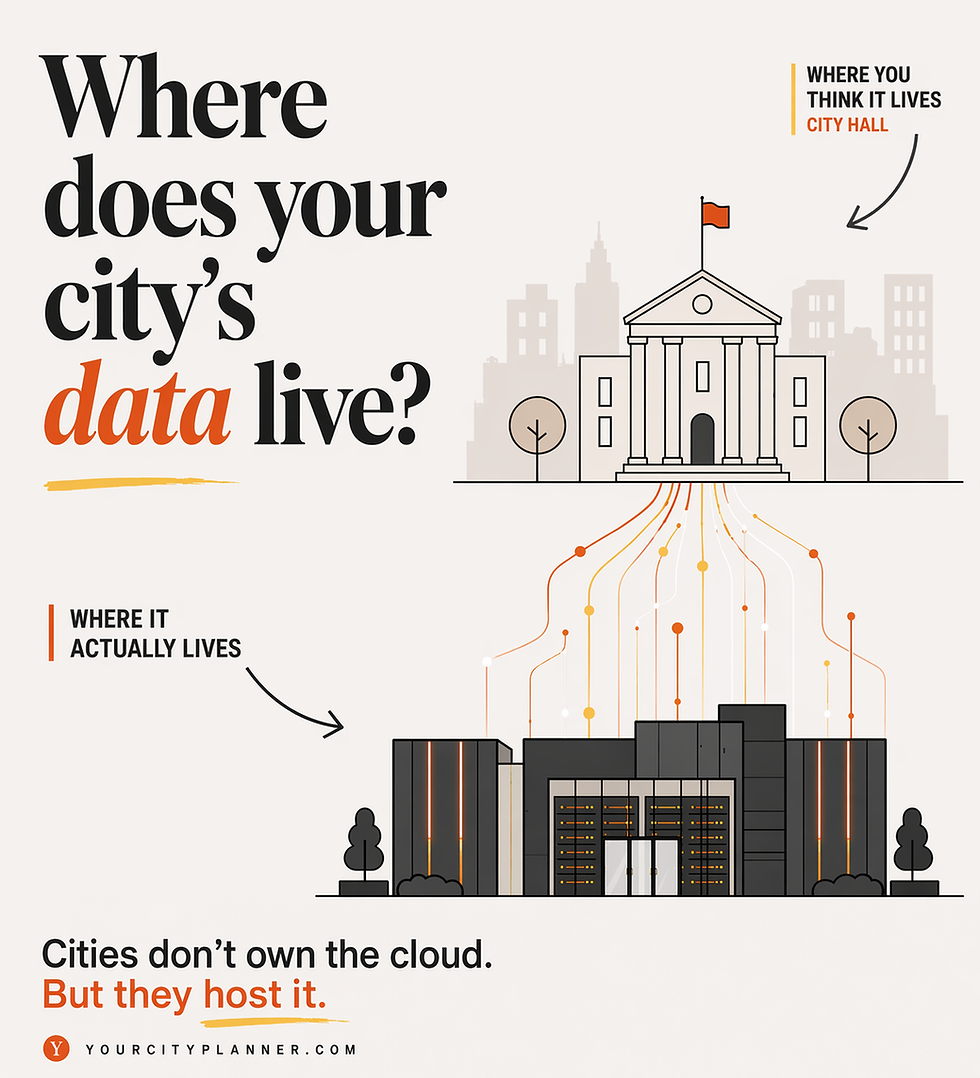
If you asked where your city's data lives, City Hall would be the obvious guess. It's where decisions are made, where records are kept, where government, in theory, governs. But increasingly, your city doesn't actually run from City Hall.


Every time you pay a bill online, check a transit app, apply for housing assistance, or call 311, your information isn't staying within the walls of local government. It's moving through a web of cloud platforms, software vendors, and data centers; often owned by companies far outside your city, and sometimes far outside your country.


This is what people mean when they talk about digital sovereignty. Strip away the jargon and it comes down to a deceptively simple question: Who is actually in control of the systems your city depends on?


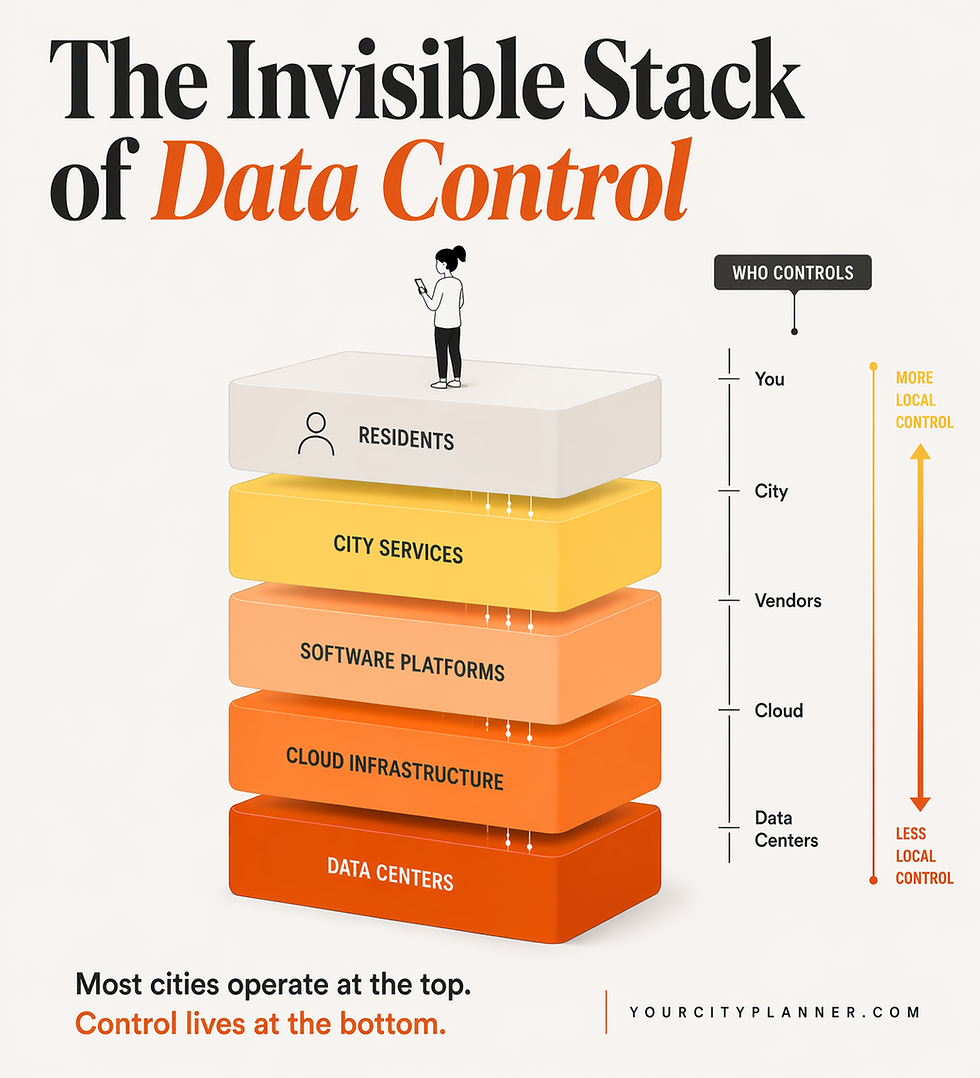
Vertical systems diagram titled “The Invisible Stack of Data Control” showing layers from residents and city services to software platforms, cloud infrastructure, and data centers, highlighting how control shifts away from local governments.

It's not just about where data is stored, though that matters. It's about who designs the architecture, who maintains the infrastructure, who sets the terms; and who holds leverage when something breaks, scales, or needs to change. Increasingly, the answer is not the city.

What makes this moment different is that digital infrastructure is no longer abstract. It has a physical footprint. It draws power. It consumes water. It competes for land. It shows up at zoning hearings and community meetings, not just in IT departments.


At the city level, digital sovereignty often looks like a planning decision disguised as a technical one. Do you approve a new data center that promises jobs and tax revenue, but will draw as much electricity as a small neighborhood? Do you outsource systems to global providers for speed and cost savings, or invest in building internal capacity that may be slower but offers real control?


These are no longer back-office decisions. They are infrastructure choices, the kind cities used to make about roads and water mains.


Where does your city’s data live?” showing a city hall icon contrasted with a data center icon, illustrating how urban services rely on cloud infrastructure and external data systems.

At the state level, the conversation shifts to resources. As demand for computing power grows, so does demand for energy. States are beginning to face genuine tradeoffs: who gets access to power when supply is constrained? Housing, manufacturing, and small businesses, or large-scale data operations that promise long-term economic growth?


Meanwhile, states are quietly becoming regulators of the digital layer itself. Data privacy laws, procurement rules, and utility policies all shape how much control residents actually have over their own information; even if most people never see those decisions being made.


At the national level, the tone sharpens. Governments talk about security, independence, and competitiveness. Some require that data be stored within their borders. Others invest heavily in domestic infrastructure. Many do both, and then quietly strike partnerships with the same handful of global tech companies they're supposedly guarding against.


Here's the part that rarely gets said out loud: even as governments push for "sovereignty," much of the infrastructure is still designed, financed, and operated by a relatively small group of firms, most of them based in the United States.


So you get a layered, sometimes contradictory dynamic. A country wants control over its digital future. A state wants to manage its resources responsibly. A city wants investment, innovation, and operational efficiency. A community wants to understand why a new building is using so much power and water.


And somewhere in the middle, a data center gets approved.


This isn't quite digital imperialism. But it isn't entirely neutral, either. It's a negotiation. One that plays out through contracts, zoning approvals, incentive packages, and infrastructure investments. And like most infrastructure negotiations, the benefits and burdens are not evenly distributed.


The companies that build and operate these systems gain scale, market share, and long-term contracts. Cities gain access to tools and capabilities they couldn't build on their own. Residents get faster services, more seamless experiences, and new forms of access. But control becomes more diffuse. Dependencies deepen. And the ability to change course, or even fully understand the system, becomes more complicated.


Here's what cities often miss about their own position: they have more leverage than they think.


Infographic explaining how data centers are the new civic infrastructure, showing the connection between urban systems, cloud computing, and modern city operations.

Cities don't need to own the cloud to shape it. But they do need to understand where they sit within it. Because cities are not passive users of this system, they are hosts. They provide the land, the permits, the workforce, the energy grid, and the political approval that makes this infrastructure possible. They sit at the application layer, where demand is created and felt most directly.


The real issue is whether cities use that leverage, or keep giving it away.


The decisions being made right now, often quietly, in planning departments and procurement offices and utility commissions, are setting the terms for how cities will function in a digital economy for decades. For most residents, this will remain invisible, until it isn't. Until a system goes down. Until costs spike. Until access changes.


Infrastructure is always political. The only thing new is that most people don't realize this is infrastructure. They assume the system is controlled, that someone responsible is holding the keys. Cities are. The question is whether they've noticed they've been loaning them out.


Interested in writing, speaking, or advisory collaborations?

Thanks for reaching out!

copyright © 2026 | Your City Planner | all rights reserved  

www.yourcityplanner.com

bottom of page