top of page

ARTICLES

Inspirations Blog: Headliner

Most people experience cities without thinking much about the systems behind them. A train arrives on time. A neighborhood begins to change. A stadium fills with fans. A new technology quietly reshapes the way people move, pay, work, or connect. Those moments rarely happen by accident. Every article begins with a real observation and follows it back to the leadership, infrastructure, technology, economics, and public decisions that made it possible.

Inspirations Blog: Blog2

In the spring of 2012, I found myself walking through a favela in Rio de Janeiro with a group of graduate students from Columbia University. The World Cup was still two years away. The Olympics were four years away. Construction cranes dotted the skyline, ambitious plans filled presentation boards, and from everything we had read about the plans Rio had there was an undeniable sense that Rio was on the verge of something extraordinary.


I wasn’t there as a tourist. I was a graduate school teaching assistant for our urban planning studio, whose client was Rio’s housing department. Our team was tasked with studying how the upcoming World Cup and Olympics could reshape neighborhoods, particularly around Porto Maravilha, where decades of disinvestment were giving way to one of the city’s most ambitious redevelopment efforts.


Ironically, for a planning studio centered on the World Cup and the Olympics, I don't remember us spending much time talking about soccer or any other Olympic sport. Our sport was observing the city. Somewhere between meetings, neighborhood visits, and late-night planning debates, I even got to practice my "Portuñol" with cab drivers, waiters, and bartenders. Looking back, I realize I wasn't just learning about Rio. I was learning how to see a city. 


One of my favorite things to do is simply walking around cities. Not to check landmarks off a list, but to notice how they work. I find myself paying attention to the things most people walk right past: how people move through a street, why one plaza is full while another sits empty, how buses connect neighborhoods, or how the feeling of a place can completely change within a few blocks. It is probably the urban planner in me, but I’ve come to realize that every city has something to teach you if you are willing to slow down and look.


As we talked with residents, visited neighborhoods, and debated ideas late into the evening, one question kept resurfacing: would the city actually be better off after the world went home?


That question wasn’t unique to Rio. It was one our professors challenged us with throughout graduate school. No matter how exciting the proposal, how ambitious the design, or how impressive the numbers, we were always pushed to ask the same thing: so what...will the city be better off?


It sounds like a simple question, but I’ve come to realize it is one of the hardest questions in city planning. Hosting a global event like the World Cup is not just about stadiums or ticket sales. It is about housing, transportation, public safety, tourism, local businesses, public spaces, and thousands of decisions that determine whether one extraordinary month leaves behind something that improves everyday life for the people who call the city home.


Years later, that same question came back to me as I watched the United States, Mexico, and Canada host the 2026 FIFA World Cup. Only this time, something felt different. Instead of asking, What are these countries building? I found myself asking, Why aren’t they building very much at all?


The answer, I believe, says a great deal about how cities have evolved and perhaps even more about what we have learned from hosting mega-events over the last two decades.


Editorial illustration of soccer fans walking through downtown Seattle during the 2026 FIFA World Cup with the headline "Come Walk With Me." The graphic introduces a city planner's perspective on how host cities experience global sporting events beyond the matches.
Every World Cup begins with people experiencing a city, not just attending a match.

Bigger Isn’t Always Better

It is easy to forget the mindset of the early 2010s. Back then, hosting the World Cup or the Olympics often felt like winning the lottery. Cities competed aggressively because the prevailing belief was that these events would put them on the global map, attract investment, and accelerate long-awaited infrastructure projects.


The formula seemed straightforward. Build the stadiums. Expand the airport. Extend the transit system. Construct athlete villages. Beautify the city. The economic benefits would follow.


Of course, reality proved far more complicated. Some investments transformed cities for the better. Others became cautionary tales. Many sparked debates that continue today about public spending, housing displacement, and whether the promised economic benefits ever fully materialized.


Our studio wasn't trying to determine whether Brazil should host the World Cup. We were asking something much more practical. If billions of dollars are about to be invested in a city anyway, how can those investments leave residents better off long after the final match is played? 


Looking back, I realize we were really asking a broader question that applies to almost every major public investment: who is all of this ultimately for?


A Different Kind of World Cup

The more I paid attention to how the United States, Mexico, and Canada were preparing for the 2026 World Cup, the more I realized this tournament is not defined by what was built. It is defined by what already existed.


That may sound obvious, but it is actually a remarkable shift.


Think about the iconic images from previous World Cups and Olympic Games. Brand new stadiums. Massive athlete villages. Entire districts transformed seemingly overnight. Whether those investments proved worthwhile is another conversation, but they were impossible to miss.


This time, many of the biggest investments are almost invisible. They are happening in airports, transit systems, emergency operations centers, digital wayfinding, security coordination, hotels, and fan festivals.


One thing that genuinely surprised me was seeing fan festivals pop up in cities that were not hosting a single match. At first, I found myself wondering why. Then it clicked. The World Cup was not just arriving in sixteen host cities. It was rippling across three entire countries.


A friend recently told me his annual guys’ trip to Las Vegas looked completely different this year. Instead of planning around late-night clubs, his group was planning around kickoff times. Day drinking had become central to their itinerary.


It is a funny observation, but it illustrates something planners sometimes overlook. Mega-events do not just reshape skylines. They reshape how cities are used.


Editorial graphic showing the 16 FIFA World Cup 2026 host cities across the United States, Mexico, and Canada, highlighting how one global tournament creates local impacts in every host city through transportation, tourism, and public space.
One tournament. Sixteen host cities. Three countries. Thousands of local decisions.

Perhaps the biggest difference between Rio and 2026 is not infrastructure at all. It is complexity.


In Rio, much of the complexity centered on physical transformation. How do you finance, design, approve, and build massive infrastructure projects in time for the world to arrive?


In 2026, the infrastructure largely already exists. Now the challenge is operational. Can airports, transit agencies, police departments, emergency responders, volunteers, hotels, technology systems, and local businesses all operate as one coordinated network across three countries?


As someone who now spends much of my professional life bringing organizations together around shared goals, I have to admit I find that challenge fascinating. Building a stadium is incredibly difficult. But honestly, building the stadium might have been the easier part.


Editorial graphic comparing the infrastructure-focused approach of previous FIFA World Cups with the operational coordination required for the 2026 tournament across North America, emphasizing that today's challenge is coordinating a continent rather than building new stadiums.
The biggest challenge of the 2026 World Cup isn't building stadiums, it's coordinating an entire continent.

Three Countries. Three Different Lessons.

One of the things I did not appreciate at first is that this is not one host country. It is three. Each one seems to be teaching us something different about what it means to host a mega-event in 2026.


The United States is perhaps the easiest place to see this evolution. It is not really hosting one World Cup. It is hosting eleven different versions of it: Atlanta, Boston, Dallas, Houston, Kansas City, Los Angeles, Miami, New York/New Jersey, Philadelphia, San Francisco Bay Area, and Seattle.


Each host city has its own personality, transportation network, climate, governance structure, tourism economy, and fan culture. Yet somehow they all have to feel like they are part of the same tournament. That is an extraordinary coordination challenge.


It is also a reminder that a country’s greatest infrastructure asset is not always a stadium or a highway. Sometimes it is the ability to get hundreds of organizations moving in the same direction.


As anyone who has worked across multiple organizations knows, that is easier said than done. Everyone loves collaboration until someone sends the calendar invite.


Mexico tells a different story. Rather than asking, What should we build? The question seems to be, How do we honor what we already have while preparing for what comes next? There is something refreshing about that. Cities do not always have to reinvent themselves. Sometimes they simply need to evolve.


Canada offers yet another lesson. Hosting a World Cup has become as much about demonstrating fiscal discipline and long-term thinking as it is about putting on a spectacular event.


That shift feels significant. Not long ago, cities competed by announcing the biggest projects. Today, they are increasingly expected to explain something much less glamorous: how will this investment improve life after the tournament?


Ironically, that is often the harder sell. 


What We Don’t See

A great tournament experience can feel effortless from the outside. Fans arrive, follow signs, board trains, find food, celebrate in plazas, and make it home safely. If everything works, most people never stop to think about how much coordination made that experience possible.


But behind that ease is a web of agencies, businesses, workers, volunteers, technology systems, and public decisions that have to align in real time. Airports have to absorb visitors. Transit agencies have to adjust service. Police and emergency responders have to coordinate across jurisdictions. Hotels, restaurants, small businesses, and fan zones all become part of the city’s operating system.


That is the part of mega-events I find most interesting now. Not just the spectacle, but the choreography behind it.


Split-panel editorial graphic comparing what FIFA World Cup fans experience during a month-long tournament with the hundreds of organizations and thousands of decisions that coordinate transportation, safety, hospitality, and public services behind the scenes.
The tournament lasts about a month. The coordination behind it begins years earlier.

Cities Succeed Because of Everyday Moments

Over the years, I have come to believe that cities do not succeed because of ribbon cuttings. They succeed because of how people experience them every day. 


Ribbon cuttings are exciting because they are tangible. You can point to a new station, a new stadium, or a new civic building. They are photogenic, easy to celebrate, and much easier to raise money for.


The harder work begins after everyone goes home. Maintaining those assets. Training staff. Updating technology. Strengthening coordination between agencies. Making sure thousands of small operational details continue working year after year.


No mayor proudly cuts a ribbon to celebrate better interagency communication. No commemorative plaque honors decades of preventative maintenance. And yet those investments are often the reason a city feels safe, efficient, and welcoming.


So How Will We Know If Cities Were Better Off?

After all these years, I keep coming back to the same question we asked in Rio. Will the city be better off?


The funny thing about asking whether a city is “better off” is that you cannot really answer it when the tournament ends. In fact, that is probably the worst possible time to ask.


The confetti is still being swept off the streets, hotels are reporting record occupancy, restaurants are celebrating their busiest month of the year, and everyone is still riding the emotional high of hosting the world. Of course everything feels like a success.


But that was not the question we were trying to answer in Rio, and it is not the question I am asking today. The question was never whether the World Cup would create an unforgettable month. The question was whether it would create a better city.


And that answer takes time.


The real evaluation does not begin until life returns to normal. The volunteers go back to their day jobs, the fan festivals disappear, the television cameras leave, and visitors head home. That is when you begin to see whether all of those investments changed anything for the people who never bought a ticket in the first place.


Does the train arrive a little more reliably on a rainy Tuesday morning? Do families still enjoy the public spaces that were activated during the tournament? Did local businesses build new relationships that continue long after the final whistle? Did governments learn how to collaborate a little better the next time a crisis, or an opportunity, come along?


Those are not the kinds of stories that make the evening news. But they might be the ones that matter most.


Looking Beyond the Final Whistle

I still keep in touch with several friends from that Columbia planning studio, and every once in a while I catch myself wondering what would happen if we all met back in Rio.


Would we think the city is better off? Would we notice things we completely missed in 2012? Would we ask different questions now that we have spent another fourteen years learning how cities really work? Or would we realize that our original question was the right one all along?


One of the first lessons I learned in graduate school was that every planning project eventually comes back to the same question: so what...will the city be better off?


Years later, I still find myself asking it.


As I watch the United States, Mexico, and Canada host the 2026 World Cup, I am optimistic. Not because the tournament appears bigger than those that came before it, but because it feels wiser.


The conversation has evolved. Yes, there are still stadiums to fill, visitors to welcome, and billions of dollars to account for. But there also seems to be a growing recognition that the true measure of success is not what we build for a month. It is what continues to serve people long after the tournament ends.


Maybe that is what maturity looks like for cities. Less focused on creating monuments. More focused on creating systems that quietly improve everyday life. As someone who loves watching cities evolve, I'm genuinely curious to see what happens next. Years ago, I walked the streets of Rio wondering whether the city would be better off after the world went home. Today, I find myself asking the same question as planning continues for the next FIFA World Cup 2030 across Morocco, Spain, and Portugal. The cities are different. The context is different. But the question remains the same. It'll be fascinating to see which lessons carry forward and what new ones emerge.


Cities are not judged by how they perform during extraordinary moments. They are judged by how they serve people once ordinary life returns.
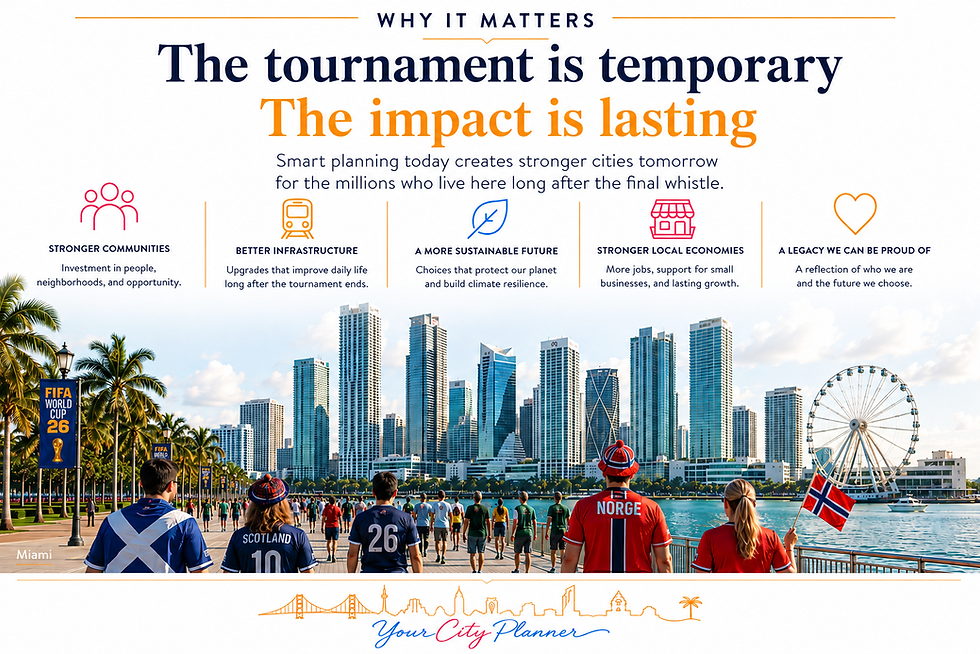

Illustration of downtown Miami during the 2026 FIFA World Cup with international soccer fans gathering near the waterfront, highlighting the lasting impact global sporting events can have on cities long after the tournament ends.
The final whistle ends the tournament. The city's story is just beginning.

The World Cup moves on. The city doesn’t.

You pay your water bill, call 311, apply for housing help. Your information travels somewhere. The question is where, and who's in charge when it gets there.


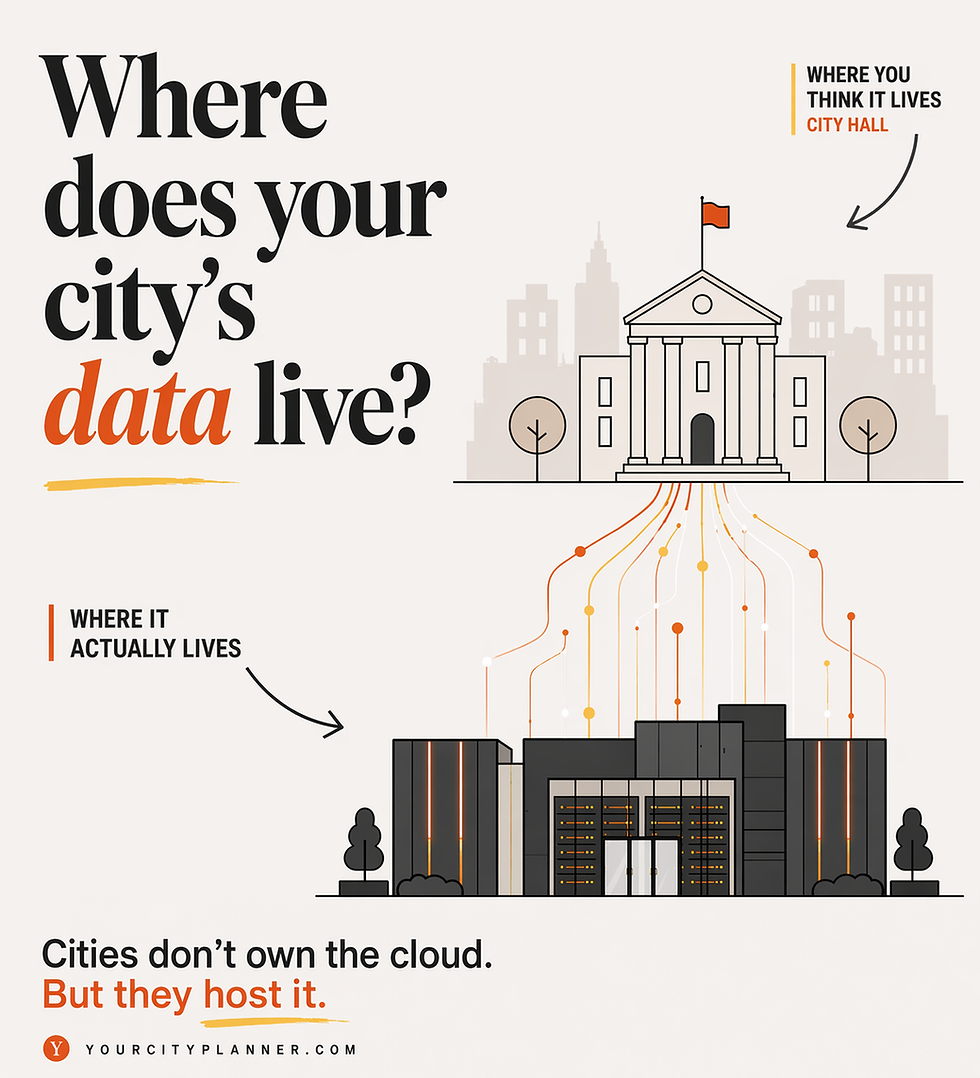
Infographic about data sovereignty showing a city skyline connected to a data center, illustrating how cities rely on cloud computing and digital infrastructure for public services.

If you asked where your city's data lives, City Hall would be the obvious guess. It's where decisions are made, where records are kept, where government, in theory, governs. But increasingly, your city doesn't actually run from City Hall.


Every time you pay a bill online, check a transit app, apply for housing assistance, or call 311, your information isn't staying within the walls of local government. It's moving through a web of cloud platforms, software vendors, and data centers; often owned by companies far outside your city, and sometimes far outside your country.


This is what people mean when they talk about digital sovereignty. Strip away the jargon and it comes down to a deceptively simple question: Who is actually in control of the systems your city depends on?


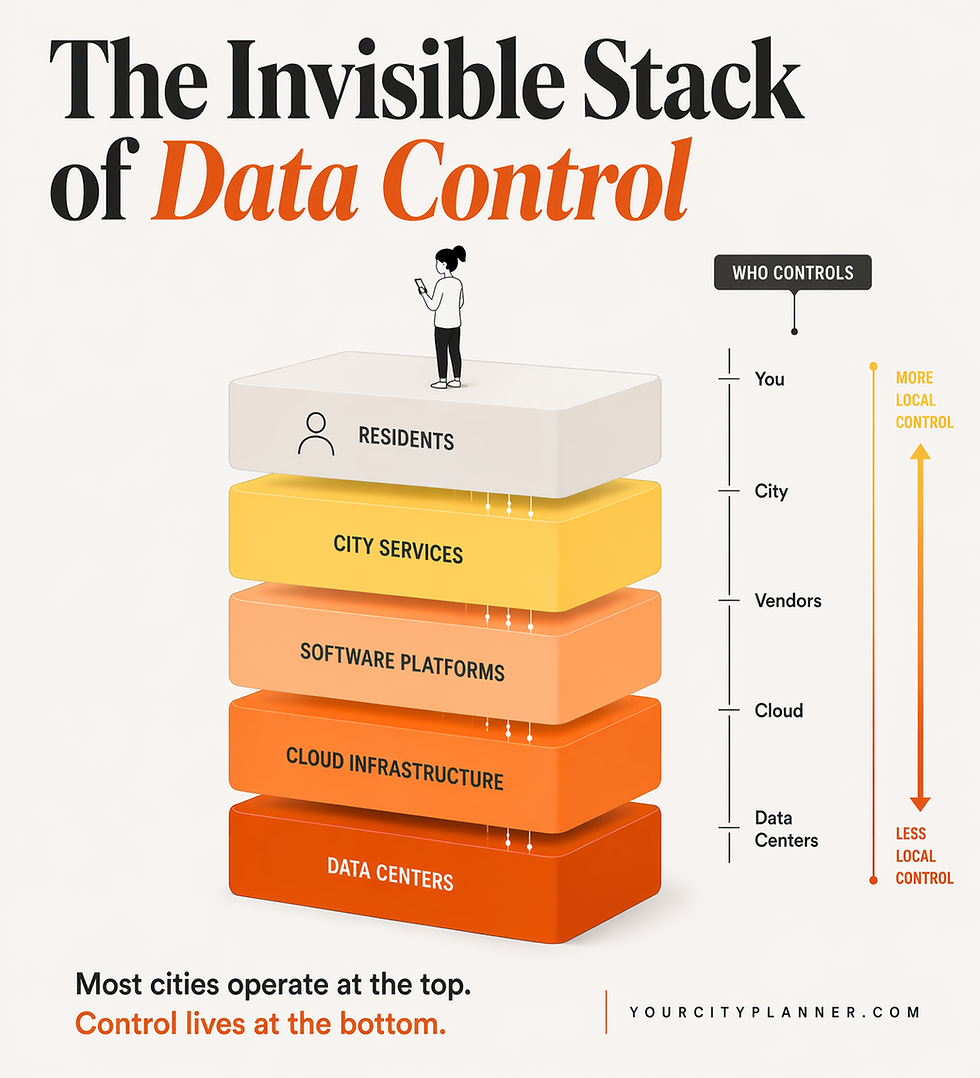
Vertical systems diagram titled “The Invisible Stack of Data Control” showing layers from residents and city services to software platforms, cloud infrastructure, and data centers, highlighting how control shifts away from local governments.

It's not just about where data is stored, though that matters. It's about who designs the architecture, who maintains the infrastructure, who sets the terms; and who holds leverage when something breaks, scales, or needs to change. Increasingly, the answer is not the city.

What makes this moment different is that digital infrastructure is no longer abstract. It has a physical footprint. It draws power. It consumes water. It competes for land. It shows up at zoning hearings and community meetings, not just in IT departments.


At the city level, digital sovereignty often looks like a planning decision disguised as a technical one. Do you approve a new data center that promises jobs and tax revenue, but will draw as much electricity as a small neighborhood? Do you outsource systems to global providers for speed and cost savings, or invest in building internal capacity that may be slower but offers real control?


These are no longer back-office decisions. They are infrastructure choices, the kind cities used to make about roads and water mains.


Where does your city’s data live?” showing a city hall icon contrasted with a data center icon, illustrating how urban services rely on cloud infrastructure and external data systems.

At the state level, the conversation shifts to resources. As demand for computing power grows, so does demand for energy. States are beginning to face genuine tradeoffs: who gets access to power when supply is constrained? Housing, manufacturing, and small businesses, or large-scale data operations that promise long-term economic growth?


Meanwhile, states are quietly becoming regulators of the digital layer itself. Data privacy laws, procurement rules, and utility policies all shape how much control residents actually have over their own information; even if most people never see those decisions being made.


At the national level, the tone sharpens. Governments talk about security, independence, and competitiveness. Some require that data be stored within their borders. Others invest heavily in domestic infrastructure. Many do both, and then quietly strike partnerships with the same handful of global tech companies they're supposedly guarding against.


Here's the part that rarely gets said out loud: even as governments push for "sovereignty," much of the infrastructure is still designed, financed, and operated by a relatively small group of firms, most of them based in the United States.


So you get a layered, sometimes contradictory dynamic. A country wants control over its digital future. A state wants to manage its resources responsibly. A city wants investment, innovation, and operational efficiency. A community wants to understand why a new building is using so much power and water.


And somewhere in the middle, a data center gets approved.


This isn't quite digital imperialism. But it isn't entirely neutral, either. It's a negotiation. One that plays out through contracts, zoning approvals, incentive packages, and infrastructure investments. And like most infrastructure negotiations, the benefits and burdens are not evenly distributed.


The companies that build and operate these systems gain scale, market share, and long-term contracts. Cities gain access to tools and capabilities they couldn't build on their own. Residents get faster services, more seamless experiences, and new forms of access. But control becomes more diffuse. Dependencies deepen. And the ability to change course, or even fully understand the system, becomes more complicated.


Here's what cities often miss about their own position: they have more leverage than they think.


Infographic explaining how data centers are the new civic infrastructure, showing the connection between urban systems, cloud computing, and modern city operations.

Cities don't need to own the cloud to shape it. But they do need to understand where they sit within it. Because cities are not passive users of this system, they are hosts. They provide the land, the permits, the workforce, the energy grid, and the political approval that makes this infrastructure possible. They sit at the application layer, where demand is created and felt most directly.


The real issue is whether cities use that leverage, or keep giving it away.


The decisions being made right now, often quietly, in planning departments and procurement offices and utility commissions, are setting the terms for how cities will function in a digital economy for decades. For most residents, this will remain invisible, until it isn't. Until a system goes down. Until costs spike. Until access changes.


Infrastructure is always political. The only thing new is that most people don't realize this is infrastructure. They assume the system is controlled, that someone responsible is holding the keys. Cities are. The question is whether they've noticed they've been loaning them out.


  • Mar 19
  • 5 min read

Across America, cities are competing to host the infrastructure that powers artificial intelligence.


Abilene isn’t the only city chasing the AI boom.


Across the United States, communities from the high plains of Wyoming to the manufacturing corridors of Ohio are positioning themselves as hubs for the next generation of digital infrastructure. Local leaders increasingly see AI data centers as the modern equivalent of railroads or factories that, while they require massive upfront investments, also have the power to anchor regional economies for decades.


But the new infrastructure economy comes with a twist. Artificial intelligence facilities require extraordinary amounts of electricity, land, and fiber connectivity, while employing far fewer workers than the industrial plants many communities once depended on.


For cities hoping to become AI boomtowns, the rewards, and the risks, are coming into focus.


Map of the United States highlighting key AI data center hubs including Abilene, Texas; Cheyenne, Wyoming; Mesa, Arizona; Ashburn, Virginia; Columbus, Ohio; and Richmond County, North Carolina, with icons showing electricity, fiber, land, workforce, and incentives.

Cheyenne, Wyoming: Power on the High Plains

Cheyenne, the capital of Wyoming, has quietly become one of the country’s more strategic locations for digital infrastructure.


Over the past decade, the region has attracted a series of major data center investments, beginning with large campuses developed by Microsoft. The appeal is straightforward: abundant energy, inexpensive land, and proximity to long-haul fiber routes that follow major interstate corridors across the western United States.


Wyoming’s energy resources have been particularly important. The state produces far more electricity than it consumes, thanks to its mix of wind generation and traditional power plants. For hyperscale operators building facilities that can draw hundreds of megawatts, that surplus matters.


Like many modern data center campuses, the facilities outside Cheyenne are physically large but operationally quiet. Once construction crews leave, a campus that may cost billions of dollars can operate with only a few hundred technicians and engineers.


For Wyoming officials, the calculation is less about employment than about long-term tax revenue and positioning the state within the infrastructure economy that underpins cloud computing and artificial intelligence.


Mesa, Arizona: Silicon Desert

Outside Phoenix, the desert has become one of the fastest-growing digital infrastructure markets in the country.


Mesa and the broader Phoenix metropolitan region now host dozens of data centers, with estimates suggesting more than 70 facilities and roughly 20 million square feet of data center space across the region.


Arizona’s growth reflects a powerful convergence of forces. Massive semiconductor investments, including fabrication plants from companies such as TSMC and Intel, have turned the Phoenix area into one of North America’s most important technology manufacturing hubs.


Data centers naturally follow.


AI systems require enormous computing power, which in turn depends on the same semiconductor supply chains and engineering ecosystems that support advanced chip manufacturing. The result is an increasingly dense technology cluster stretching across the desert.


What has emerged is less a single campus than a regional infrastructure network. A digital backbone supporting artificial intelligence, cloud computing, and advanced manufacturing.


Ashburn, Virginia: The Internet’s Capital

If any place represents the center of the global data center industry, it is Ashburn, Virginia.


Located in Loudoun County outside Washington, D.C., the region has become the world’s largest concentration of data centers, with more than 300 facilities and an estimated 30 million square feet of server space.


A significant share of the world’s internet traffic passes through fiber exchanges located in Northern Virginia, making the region one of the most important digital crossroads on the planet.


Unlike newer AI infrastructure hubs, Ashburn’s rise was not the result of a single economic development strategy. Instead, it grew gradually from its position as a telecommunications nexus during the early expansion of the commercial internet.


Today, hyperscale operators including Amazon Web Services, Google, and Microsoft operate massive campuses across the region.


But the very success of Northern Virginia’s data center industry has created new tensions. Electricity demand has surged, forcing utilities and regulators to confront a difficult question: how quickly can the power grid expand to support the next generation of AI computing?


Comparison chart of major AI data center regions showing number of facilities, estimated square footage, and key advantages across Abilene, Cheyenne, Mesa, Ashburn, Columbus, and Richmond County.

Columbus, Ohio: The Midwest AI Corridor

In central Ohio, a different model is emerging.


Columbus has become one of the fastest-growing technology markets in the Midwest, fueled in part by major investments from Amazon Web Services, Google, and Meta. Across the region, dozens of data centers are operating or under construction, contributing to a footprint estimated between 15 and 20 million square feet.


The region’s appeal lies partly in geography. Columbus sits within a day’s drive of major Midwestern population centers while offering relatively affordable land and reliable power infrastructure.


Workforce pipelines have also played a role. Institutions such as Ohio State University produce engineering and technical talent that helps support the growing technology sector.


State and local governments have aggressively pursued data center investment as part of a broader effort to reposition the Midwest within the digital economy.


For a region long associated with manufacturing, the infrastructure of artificial intelligence represents a new kind of industrial strategy.


Richmond County, North Carolina: The Rural Revival Bet

In rural North Carolina, the calculus looks different.


Communities like Richmond County see AI infrastructure as a potential successor to the manufacturing plants and textile mills that once anchored local economies, and have begun attracting investment from companies like Amazon.


Local officials have assembled large tracts of land and approved incentive packages designed to attract hyperscale development. The pitch is simple: affordable land, available power infrastructure, and a regulatory environment that allows projects to move quickly.


For many rural regions, the hope is that data centers can spark a new wave of investment.


But the economic model differs sharply from the factories these communities once depended on. Data centers bring massive capital spending during construction but relatively small permanent workforces once operations begin.


For local leaders, the promise often lies in long-term property tax revenue rather than job creation.


The Infrastructure Equation

Triangle diagram illustrating the core requirements of AI data centers: electricity, land, and fiber, converging to support hyperscale artificial intelligence infrastructure.

Despite their geographic differences, the cities competing for AI investment share a remarkably similar formula.


Hyperscale data centers require three resources above all else: electricity, land, and fiber.


Electricity has become the most critical constraint. Modern AI training clusters can consume hundreds of megawatts of power, sometimes approaching the output of a large nuclear reactor. In many cases, utilities must build entirely new substations or transmission lines to support these facilities.


Infographic comparing electricity demand of a hyperscale AI data center to a nuclear power plant, steel mill, and small city, showing that large data centers can consume up to 1.2 gigawatts of power.

Land is the second requirement. AI campuses require large parcels to accommodate server halls, cooling systems, substations, and future expansion.


Fiber networks complete the equation. High-capacity connections are essential for linking AI systems to cloud platforms and global internet exchanges.


Local governments can accelerate permitting and offer tax incentives, but they cannot build power plants or fiber routes overnight. Increasingly, the pace of AI infrastructure development depends less on economic development strategy than on the physical limits of the electrical grid.


The Boomtown Question

Side-by-side comparison of traditional manufacturing plants and hyperscale data centers showing job counts and wage ranges, highlighting fewer but higher-paid jobs in data centers.

Across the country, cities are racing to attract the infrastructure that will power artificial intelligence.


The investments are enormous. Individual campuses can cost billions of dollars and consume as much electricity as small cities.


Yet the economic equation differs from the industrial booms that once reshaped American towns.


Traditional factories often employed hundreds or thousands of workers. Hyperscale data centers typically operate with only a few hundred permanent staff once construction ends.


For many communities, the real promise lies in property tax revenue and the possibility of becoming a strategic node in the digital economy.


But the incentives used to attract these projects raise a deeper question.


If communities compete too aggressively by offering too large tax abatements and subsidies, then the public return on these investments becomes harder to measure.


In that sense, the rise of AI boomtowns may represent a new kind of economic gamble.


One defined less by assembly lines and smokestacks than by server racks, fiber cables, and transmission lines.


And yet the geography of the digital world is shifting.


Places once known for oil fields, rail yards, or farmland are becoming part of the physical backbone of artificial intelligence.


Whether these communities are witnessing the beginning of a durable infrastructure economy, or simply the latest chapter in America’s long history of boomtowns remains an open question.


But the map of where the future is being built is already changing.


And increasingly, it runs through places few people recognize, and far from the traditional centers of the technology industry.


Checklist-style infographic showing what AI data centers look for in locations, including affordable power, fiber connectivity, low-cost land, cooling climate, and tax incentives.

Interested in writing, speaking, or advisory collaborations?

Thanks for reaching out!

copyright © 2026 | Your City Planner | all rights reserved  

www.yourcityplanner.com

bottom of page