
AI’s Hardest Test Is the City
- Jan 25
- 5 min read
Editor’s note: Across the country, cities are grappling with how to govern artificial intelligence without either stifling innovation or surrendering public authority. Federal guidance remains fragmented, state approaches uneven, and private infrastructure providers increasingly shape how and where AI is deployed. This essay examines Miami’s Brickell AI Digital Twin not as a technical showcase, but as a governance experiment: one that treats cities as platforms for validation, constraint, and public accountability in the age of physical AI.
As artificial intelligence leaves the lab and confronts the real world, cities are becoming its most consequential testing ground; not because they are eager adopters, but because they are where complexity refuses to be abstracted away.
Urban environments expose AI to weather, infrastructure limits, human behavior, and political consequence all at once. Every assumption is stressed. Every shortcut becomes visible. Every failure has a public face.
At some point, serious technology must encounter reality. For the next generation of AI systems, that reality is urban. Streets may eventually host deployment, and neighborhoods may absorb experimentation but only after risk has been narrowed, trade-offs surfaced, and consequences modeled as rigorously as possible.
Cities, unlike startups, do not get to treat learning as acceptable fallout.
That is precisely why they matter.
“Physical AI” is one of those phrases that sounds more mystical than it is. Strip away the branding, and it refers to a straightforward idea: AI systems designed to sense, interpret, and respond to conditions in the physical world. Not abstract datasets, but weather, traffic, energy loads, infrastructure stress, and human behavior as they unfold in real time.
Cities are the most complex physical environments humans have ever built. That makes them indispensable to AI, and impossible for AI to master without constraint.
Miami’s Brickell AI Digital Twin exposes a truth many policymakers resist: cities do not control AI. They shape the conditions under which it learns.
What Physical AI Actually Means
Physical AI matters not because it replaces human judgment, but because it anchors digital models in reality.
A digital twin without physical AI is static, a snapshot frozen in time. With physical AI, it becomes dynamic, continuously updated by signals from the city itself. Sensors embedded across urban infrastructure feed real-time information into the system, allowing models to adjust as conditions change rather than relying on historical assumptions.
In practice, the loop looks like this:
Sensors capture real-world conditions like traffic volumes, flood levels, weather shifts, energy demand, and infrastructure stress. In cities, these sensors are typically embedded in traffic signals, utility systems, flood monitors, weather stations, building management systems, and other public assets.
Simulation platforms model scenarios using that live data, testing how systems respond to storms, heat waves, construction activity, or sudden surges in demand.
Predictive models surface risks and trade-offs, identifying where failures, bottlenecks, or cascading impacts are most likely.
City experts interpret the results and decide how to act.
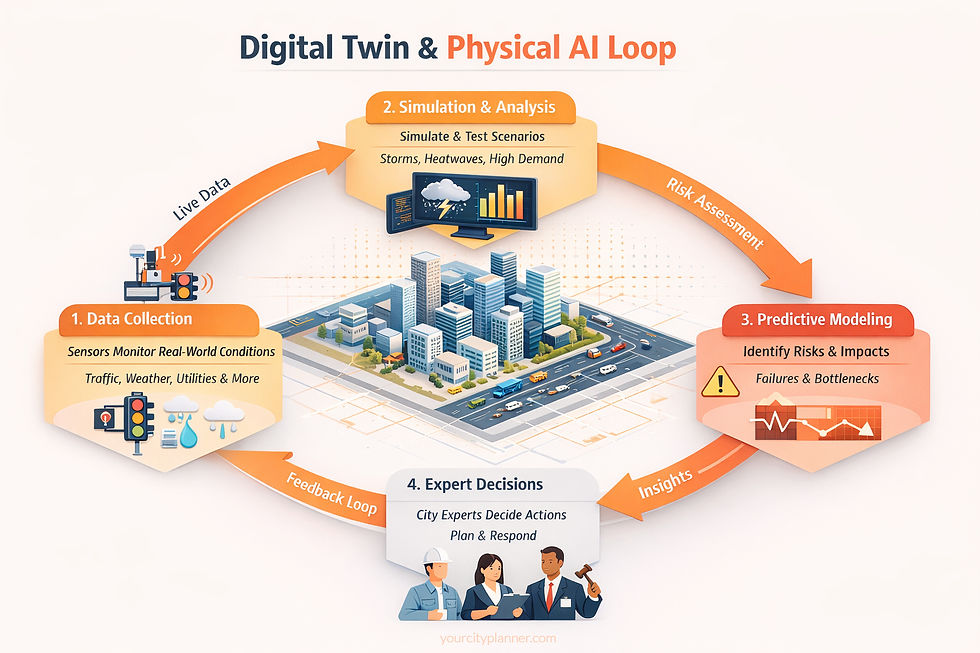
That final step is essential. Cities are not closed systems. Data can reveal pressure points, but it cannot resolve competing priorities around equity versus efficiency, speed versus safety, innovation versus public trust. That work still belongs to engineers, planners, emergency managers, and elected officials.
The city remains decisional. The AI remains advisory. Not because the technology is weak, but because the environment is irreducibly complex.
The digital twin does not replace planning departments or emergency managers. It gives them a constrained environment where hypotheses can be tested, blind spots exposed, and consequences examined before reality absorbs the cost.
The City as a Constraint System
What makes cities valuable to AI developers is not just data, it is friction.
Zoning codes, environmental regulations, safety requirements, political boundaries, and public accountability impose limits that no private lab can replicate. These constraints force emerging technologies to confront reality early, while changes are still cheap and assumptions still malleable.
In a mature digital twin environment, future mobility companies could evaluate proposed air routes against noise ordinances, safety corridors, and neighborhood impact long before seeking regulatory approval. Infrastructure or logistics firms could test how new concepts interact with pedestrian density, curb access, or emergency response needs without placing equipment on the street.
These are not deployments.
They are rehearsals.
The value lies in allowing innovation to collide with civic reality before the public does.
From Infrastructure to Compute: Cities as AI Platforms
Miami’s Brickell Digital Twin is not a pilot program, nor a procurement exercise. It is a layered partnership.
At the foundation, the city partnered with NVIDIA and Dell to establish the physical AI infrastructure: the compute capacity, simulation environment, and digital backbone required to model complex urban systems at scale. That layer is not experimental. It is enabling.
On top of that foundation, Miami is inviting other companies to test their own compute and model-layer technologies within the Brickell digital twin. These range from climate analytics and mobility modeling to infrastructure forecasting and risk simulation.
This distinction matters. Miami is not shopping for finished products. It is offering a city as a reference environment, where emerging technologies can be tested against real urban constraints without immediate deployment.
In effect, the city is acting as a platform host.
For participating companies, this provides something difficult to replicate elsewhere: access to high-quality infrastructure, real-time urban data, and a credible public setting in which models can be evaluated before they ever touch the street. For the city, it avoids vendor lock-in while allowing multiple technical approaches to be tested side by side.
Miami has created a structured on-ramp for companies that want to understand how their systems behave in a dense, climate-exposed, economically active urban core while keeping humans firmly in charge of interpretation and decision-making.
From Control to Leverage
Concerns about cities “losing control” to private AI misunderstand how cities already operate.
Municipal governments have long depended on private actors for infrastructure—from power and water to telecommunications and transportation. AI does not introduce dependency. It makes dependency visible.
The more meaningful question is whether cities gain leverage in return.
By positioning itself as a reference environment for validation, Miami becomes valuable to technology companies. That value creates influence over standards, transparency, accountability, and the pace at which innovations move from simulation to street.
Dependency, in this model, runs both ways.
The Real Innovation: Institutional Confidence
Miami’s real innovation is not technical sophistication. It is institutional confidence with the ability to say, We don’t need to invent this technology to govern it.
That confidence attracts capital. In the first half of 2025, nearly $830 million flowed into AI startups in the Miami metro area. Investors are responding not just to talent or ambition, but to a city that understands how innovation actually matures: through constraint, credibility, and contact with reality.
Physical AI does not become trustworthy by staying abstract. Cities do not become irrelevant by opening their doors.
The future of AI will not be decided by who trains the largest model or controls the most data. It will be decided by who is willing to let intelligence be tested, interpreted, and disciplined in public.
Miami is betting that cities are not obstacles to AI’s future, but rather its proving ground.



Comments