
top of page

ARTICLES

Inspirations Blog: Headliner

Most people experience cities without thinking much about the systems behind them. A train arrives on time. A neighborhood begins to change. A stadium fills with fans. A new technology quietly reshapes the way people move, pay, work, or connect. Those moments rarely happen by accident. Every article begins with a real observation and follows it back to the leadership, infrastructure, technology, economics, and public decisions that made it possible.

Inspirations Blog: Blog2

In the spring of 2012, I found myself walking through a favela in Rio de Janeiro with a group of graduate students from Columbia University. The World Cup was still two years away. The Olympics were four years away. Construction cranes dotted the skyline, ambitious plans filled presentation boards, and from everything we had read about the plans Rio had there was an undeniable sense that Rio was on the verge of something extraordinary.


I wasn’t there as a tourist. I was a graduate school teaching assistant for our urban planning studio, whose client was Rio’s housing department. Our team was tasked with studying how the upcoming World Cup and Olympics could reshape neighborhoods, particularly around Porto Maravilha, where decades of disinvestment were giving way to one of the city’s most ambitious redevelopment efforts.


Ironically, for a planning studio centered on the World Cup and the Olympics, I don't remember us spending much time talking about soccer or any other Olympic sport. Our sport was observing the city. Somewhere between meetings, neighborhood visits, and late-night planning debates, I even got to practice my "Portuñol" with cab drivers, waiters, and bartenders. Looking back, I realize I wasn't just learning about Rio. I was learning how to see a city. 


One of my favorite things to do is simply walking around cities. Not to check landmarks off a list, but to notice how they work. I find myself paying attention to the things most people walk right past: how people move through a street, why one plaza is full while another sits empty, how buses connect neighborhoods, or how the feeling of a place can completely change within a few blocks. It is probably the urban planner in me, but I’ve come to realize that every city has something to teach you if you are willing to slow down and look.


As we talked with residents, visited neighborhoods, and debated ideas late into the evening, one question kept resurfacing: would the city actually be better off after the world went home?


That question wasn’t unique to Rio. It was one our professors challenged us with throughout graduate school. No matter how exciting the proposal, how ambitious the design, or how impressive the numbers, we were always pushed to ask the same thing: so what...will the city be better off?


It sounds like a simple question, but I’ve come to realize it is one of the hardest questions in city planning. Hosting a global event like the World Cup is not just about stadiums or ticket sales. It is about housing, transportation, public safety, tourism, local businesses, public spaces, and thousands of decisions that determine whether one extraordinary month leaves behind something that improves everyday life for the people who call the city home.


Years later, that same question came back to me as I watched the United States, Mexico, and Canada host the 2026 FIFA World Cup. Only this time, something felt different. Instead of asking, What are these countries building? I found myself asking, Why aren’t they building very much at all?


The answer, I believe, says a great deal about how cities have evolved and perhaps even more about what we have learned from hosting mega-events over the last two decades.


Editorial illustration of soccer fans walking through downtown Seattle during the 2026 FIFA World Cup with the headline "Come Walk With Me." The graphic introduces a city planner's perspective on how host cities experience global sporting events beyond the matches.
Every World Cup begins with people experiencing a city, not just attending a match.

Bigger Isn’t Always Better

It is easy to forget the mindset of the early 2010s. Back then, hosting the World Cup or the Olympics often felt like winning the lottery. Cities competed aggressively because the prevailing belief was that these events would put them on the global map, attract investment, and accelerate long-awaited infrastructure projects.


The formula seemed straightforward. Build the stadiums. Expand the airport. Extend the transit system. Construct athlete villages. Beautify the city. The economic benefits would follow.


Of course, reality proved far more complicated. Some investments transformed cities for the better. Others became cautionary tales. Many sparked debates that continue today about public spending, housing displacement, and whether the promised economic benefits ever fully materialized.


Our studio wasn't trying to determine whether Brazil should host the World Cup. We were asking something much more practical. If billions of dollars are about to be invested in a city anyway, how can those investments leave residents better off long after the final match is played? 


Looking back, I realize we were really asking a broader question that applies to almost every major public investment: who is all of this ultimately for?


A Different Kind of World Cup

The more I paid attention to how the United States, Mexico, and Canada were preparing for the 2026 World Cup, the more I realized this tournament is not defined by what was built. It is defined by what already existed.


That may sound obvious, but it is actually a remarkable shift.


Think about the iconic images from previous World Cups and Olympic Games. Brand new stadiums. Massive athlete villages. Entire districts transformed seemingly overnight. Whether those investments proved worthwhile is another conversation, but they were impossible to miss.


This time, many of the biggest investments are almost invisible. They are happening in airports, transit systems, emergency operations centers, digital wayfinding, security coordination, hotels, and fan festivals.


One thing that genuinely surprised me was seeing fan festivals pop up in cities that were not hosting a single match. At first, I found myself wondering why. Then it clicked. The World Cup was not just arriving in sixteen host cities. It was rippling across three entire countries.


A friend recently told me his annual guys’ trip to Las Vegas looked completely different this year. Instead of planning around late-night clubs, his group was planning around kickoff times. Day drinking had become central to their itinerary.


It is a funny observation, but it illustrates something planners sometimes overlook. Mega-events do not just reshape skylines. They reshape how cities are used.


Editorial graphic showing the 16 FIFA World Cup 2026 host cities across the United States, Mexico, and Canada, highlighting how one global tournament creates local impacts in every host city through transportation, tourism, and public space.
One tournament. Sixteen host cities. Three countries. Thousands of local decisions.

Perhaps the biggest difference between Rio and 2026 is not infrastructure at all. It is complexity.


In Rio, much of the complexity centered on physical transformation. How do you finance, design, approve, and build massive infrastructure projects in time for the world to arrive?


In 2026, the infrastructure largely already exists. Now the challenge is operational. Can airports, transit agencies, police departments, emergency responders, volunteers, hotels, technology systems, and local businesses all operate as one coordinated network across three countries?


As someone who now spends much of my professional life bringing organizations together around shared goals, I have to admit I find that challenge fascinating. Building a stadium is incredibly difficult. But honestly, building the stadium might have been the easier part.


Editorial graphic comparing the infrastructure-focused approach of previous FIFA World Cups with the operational coordination required for the 2026 tournament across North America, emphasizing that today's challenge is coordinating a continent rather than building new stadiums.
The biggest challenge of the 2026 World Cup isn't building stadiums, it's coordinating an entire continent.

Three Countries. Three Different Lessons.

One of the things I did not appreciate at first is that this is not one host country. It is three. Each one seems to be teaching us something different about what it means to host a mega-event in 2026.


The United States is perhaps the easiest place to see this evolution. It is not really hosting one World Cup. It is hosting eleven different versions of it: Atlanta, Boston, Dallas, Houston, Kansas City, Los Angeles, Miami, New York/New Jersey, Philadelphia, San Francisco Bay Area, and Seattle.


Each host city has its own personality, transportation network, climate, governance structure, tourism economy, and fan culture. Yet somehow they all have to feel like they are part of the same tournament. That is an extraordinary coordination challenge.


It is also a reminder that a country’s greatest infrastructure asset is not always a stadium or a highway. Sometimes it is the ability to get hundreds of organizations moving in the same direction.


As anyone who has worked across multiple organizations knows, that is easier said than done. Everyone loves collaboration until someone sends the calendar invite.


Mexico tells a different story. Rather than asking, What should we build? The question seems to be, How do we honor what we already have while preparing for what comes next? There is something refreshing about that. Cities do not always have to reinvent themselves. Sometimes they simply need to evolve.


Canada offers yet another lesson. Hosting a World Cup has become as much about demonstrating fiscal discipline and long-term thinking as it is about putting on a spectacular event.


That shift feels significant. Not long ago, cities competed by announcing the biggest projects. Today, they are increasingly expected to explain something much less glamorous: how will this investment improve life after the tournament?


Ironically, that is often the harder sell. 


What We Don’t See

A great tournament experience can feel effortless from the outside. Fans arrive, follow signs, board trains, find food, celebrate in plazas, and make it home safely. If everything works, most people never stop to think about how much coordination made that experience possible.


But behind that ease is a web of agencies, businesses, workers, volunteers, technology systems, and public decisions that have to align in real time. Airports have to absorb visitors. Transit agencies have to adjust service. Police and emergency responders have to coordinate across jurisdictions. Hotels, restaurants, small businesses, and fan zones all become part of the city’s operating system.


That is the part of mega-events I find most interesting now. Not just the spectacle, but the choreography behind it.


Split-panel editorial graphic comparing what FIFA World Cup fans experience during a month-long tournament with the hundreds of organizations and thousands of decisions that coordinate transportation, safety, hospitality, and public services behind the scenes.
The tournament lasts about a month. The coordination behind it begins years earlier.

Cities Succeed Because of Everyday Moments

Over the years, I have come to believe that cities do not succeed because of ribbon cuttings. They succeed because of how people experience them every day. 


Ribbon cuttings are exciting because they are tangible. You can point to a new station, a new stadium, or a new civic building. They are photogenic, easy to celebrate, and much easier to raise money for.


The harder work begins after everyone goes home. Maintaining those assets. Training staff. Updating technology. Strengthening coordination between agencies. Making sure thousands of small operational details continue working year after year.


No mayor proudly cuts a ribbon to celebrate better interagency communication. No commemorative plaque honors decades of preventative maintenance. And yet those investments are often the reason a city feels safe, efficient, and welcoming.


So How Will We Know If Cities Were Better Off?

After all these years, I keep coming back to the same question we asked in Rio. Will the city be better off?


The funny thing about asking whether a city is “better off” is that you cannot really answer it when the tournament ends. In fact, that is probably the worst possible time to ask.


The confetti is still being swept off the streets, hotels are reporting record occupancy, restaurants are celebrating their busiest month of the year, and everyone is still riding the emotional high of hosting the world. Of course everything feels like a success.


But that was not the question we were trying to answer in Rio, and it is not the question I am asking today. The question was never whether the World Cup would create an unforgettable month. The question was whether it would create a better city.


And that answer takes time.


The real evaluation does not begin until life returns to normal. The volunteers go back to their day jobs, the fan festivals disappear, the television cameras leave, and visitors head home. That is when you begin to see whether all of those investments changed anything for the people who never bought a ticket in the first place.


Does the train arrive a little more reliably on a rainy Tuesday morning? Do families still enjoy the public spaces that were activated during the tournament? Did local businesses build new relationships that continue long after the final whistle? Did governments learn how to collaborate a little better the next time a crisis, or an opportunity, come along?


Those are not the kinds of stories that make the evening news. But they might be the ones that matter most.


Looking Beyond the Final Whistle

I still keep in touch with several friends from that Columbia planning studio, and every once in a while I catch myself wondering what would happen if we all met back in Rio.


Would we think the city is better off? Would we notice things we completely missed in 2012? Would we ask different questions now that we have spent another fourteen years learning how cities really work? Or would we realize that our original question was the right one all along?


One of the first lessons I learned in graduate school was that every planning project eventually comes back to the same question: so what...will the city be better off?


Years later, I still find myself asking it.


As I watch the United States, Mexico, and Canada host the 2026 World Cup, I am optimistic. Not because the tournament appears bigger than those that came before it, but because it feels wiser.


The conversation has evolved. Yes, there are still stadiums to fill, visitors to welcome, and billions of dollars to account for. But there also seems to be a growing recognition that the true measure of success is not what we build for a month. It is what continues to serve people long after the tournament ends.


Maybe that is what maturity looks like for cities. Less focused on creating monuments. More focused on creating systems that quietly improve everyday life. As someone who loves watching cities evolve, I'm genuinely curious to see what happens next. Years ago, I walked the streets of Rio wondering whether the city would be better off after the world went home. Today, I find myself asking the same question as planning continues for the next FIFA World Cup 2030 across Morocco, Spain, and Portugal. The cities are different. The context is different. But the question remains the same. It'll be fascinating to see which lessons carry forward and what new ones emerge.


Cities are not judged by how they perform during extraordinary moments. They are judged by how they serve people once ordinary life returns.
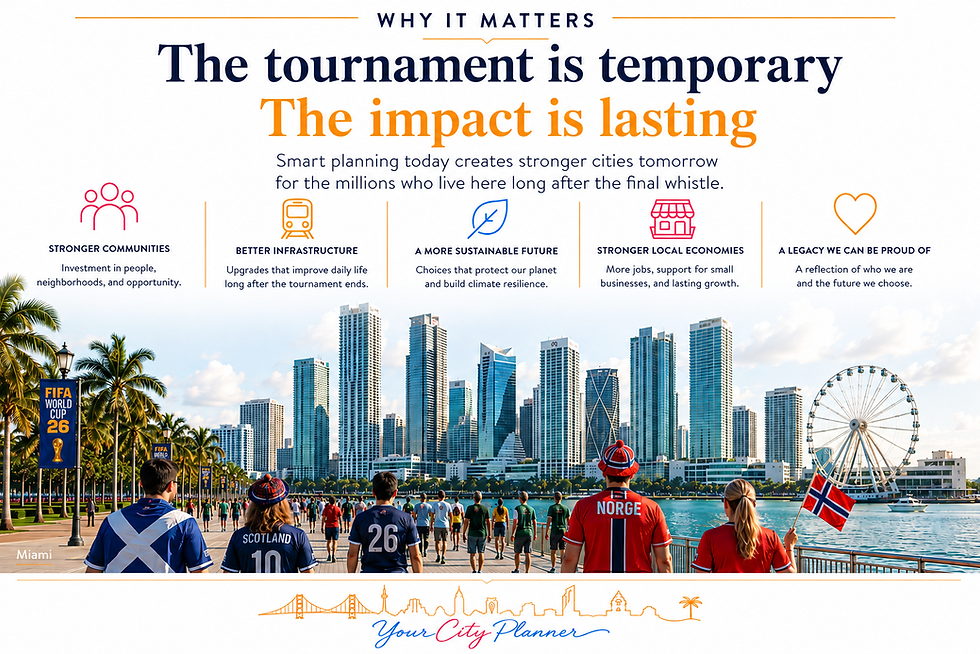

Illustration of downtown Miami during the 2026 FIFA World Cup with international soccer fans gathering near the waterfront, highlighting the lasting impact global sporting events can have on cities long after the tournament ends.
The final whistle ends the tournament. The city's story is just beginning.

The World Cup moves on. The city doesn’t.

For years, we've measured the digital divide by asking the wrong question. Can people get online? It's an easy question to answer. Broadband coverage can be mapped. Subscription rates can be counted. Internet speeds can be measured. And for more than a decade, those measurements have driven billions of dollars in investment, federal policy, and public debate. We made the case for connectivity, and in many ways, we won it.


But winning on access didn't close the divide. It just showed us a deeper one.


The next digital divide isn't about who can get online. It's about who has what they need to turn connectivity into opportunity. And that gap, between being connected and being able to do something with it, is one that leaders across government, industry, nonprofits, and education have been slow to face.


Infographic showing a staircase leading from internet access to opportunity. The steps represent confidence, digital skills, social connections, support, and guidance, illustrating that broadband access alone does not guarantee economic mobility. The graphic highlights how digital participation depends on more than connectivity.

Think about what it actually takes to apply for a job today. Most people assume the hard part is finding the right opening. It isn't. Before a real person ever reads a single word of your resume, an algorithm has already decided whether you're worth their time. Nearly every major employer now uses applicant tracking systems, software that scans, ranks, and filters candidates before they ever reach a hiring manager. According to a 2025 Jobscan analysis of Fortune 500 career pages, 97.8% of those companies use an applicant tracking system. That means the first gatekeeper in the hiring process isn't a person. It's a system. And getting through that system takes a specific kind of know-how: formatting your document the right way, matching the language in the job posting, uploading files correctly, creating yet another account on yet another platform, and following up without getting marked as spam. Nobody teaches this. None of it is obvious. And none of it has anything to do with whether someone can actually do the job.


That's what participation looks like today. Not browsing the internet. Not sending an email. Participation means being able to navigate digital systems well enough to compete in hiring, in school, in daily life, and in the economy. And by that measure, tens of millions of Americans are being left behind. Not because they aren't smart or motivated, but because the systems they're trying to use were built by and for people who already knew how to use them.


The numbers tell the story. In 2024, Pew Research found that only 57% of adults in households earning under $30,000 a year had broadband at home, compared to 95% of those earning over $100,000. That gap is about money, yes, but it's also about everything that follows from not having reliable access: the skills you never build, the systems you never learn, and the confidence you never develop. A 2023 report from the National Skills Coalition in partnership with the Federal Reserve Bank of Atlanta found that 92% of jobs analyzed require digital skills. The economy runs on digital. The barriers to getting in are not shared equally.


Side-by-side infographic comparing digital access metrics that are commonly measured, such as broadband coverage, download speed, subscription rates, device ownership, and app usage, with factors that are rarely measured, including confidence, problem-solving, digital navigation, informal learning, and support networks. The graphic illustrates the gap between measuring connectivity and measuring participation.

I know this from the inside. When I arrived at Columbia as a first-year graduate student in urban planning, I walked into a program that assumed I already knew things I didn't. We used ArcGIS to analyze geographic data, Stata to run statistical models, and Adobe Creative Cloud to present our findings. Our professors taught the concepts. Figuring out the software was on us. We learned from each other, Googled our way through it, stayed late, and figured it out.


I figured it out. But it would be too easy to say it was because I was smart or hardworking and leave it at that. The truth is more specific. I walked in with confidence, a particular kind of confidence that had been built up over years. I was always the kid people came to with questions. I remembered details that surprised people, made them laugh, made them trust me. I had already graduated from Columbia once. I had a track record. I had a voice in my head that said: you are someone who figures things out.


What I didn't have was money. I was raised by a single mother doing everything she could to keep us afloat. I grew up knowing we weren't trust fund babies, but it wasn't until I got to Columbia and looked around that I understood just how much less we had than many of the people around me. There were plenty of reasons I could have walked into that computer lab and shut down. Plenty of reasons the gap between where I started and what the program expected could have felt like too much. It didn't, because I had been given something that doesn't show up in any broadband map or skills report: the belief that I could figure it out if I put in the work. That belief didn't come from nowhere. It was built over years through relationships, small wins, and people who treated me like someone capable of more. It was more fragile than I knew at the time. And it's not something everyone gets.


Not everyone does. And that's the part of this problem that policy hasn't figured out how to fix.


We know how to build infrastructure. We've gotten better at funding devices and helping people afford internet service. We've made real progress on the physical side of digital inclusion. What we haven't done, not seriously and not at scale, is deal with the human side. The part where someone sits down in front of a computer they've never used for a task they've never done and decides whether to keep going or give up. The confidence that an unfamiliar system is something you can learn, not something designed to keep you out. The belief, which has to come from somewhere, that the digital world was built for you too.


Confidence is not a personality trait. It's something that gets built through schools, families, friends, support networks, opportunities, and experience. Which means it can be supported, or it can be left to chance. Yet many of the systems we interact with every day assume that confidence already exists. They assume people know how to navigate unfamiliar technology, troubleshoot problems, create accounts, upload documents, and recover when something goes wrong. What happens when the systems we build assume a kind of confidence most people were never given the chance to develop? A job training program that puts someone in front of a computer without addressing the fear they bring to it is a program that won't work. A digital skills class that focuses only on technical steps, and not on helping people feel like they can do this, is missing the most important part.


Iceberg infographic showing internet access above the surface and the hidden drivers of digital participation below. Beneath the surface are confidence, digital skills, friend groups, support systems, guidance, and early opportunities. The graphic demonstrates that access is only the visible part of the digital divide and that economic mobility depends on deeper forms of support and capability.

Here's what I'd ask of leaders across government, industry, nonprofits, and education: stop measuring the divide by connection rates alone. Adoption matters. Capability matters. Confidence matters. The people furthest from digital participation aren't there because they gave up. They're there because the things that build confidence, the encouragement, the families, the friends, the early wins, the adults who said "you've got this," never reached them. That's a fixable problem, but only if we're honest about what we're actually dealing with.


For leaders in every sector: the systems you build carry assumptions about who already knows how to use them, and those assumptions have real costs. Every job portal that takes four steps and three account verifications just to submit a resume is a filter. Every onboarding flow that assumes people already know the basics is a wall. Building for real participation means building for the person who has internet access but not yet the confidence to use it, and understanding that the distance between those two things is exactly where the divide lives.


Access was never the finish line. It was always just the starting point. For years, we've measured whether people could get online. The next challenge is measuring whether they can participate once they do. Because participation isn't just about devices, broadband subscriptions, or digital skills. It's about whether people have been given the tools, support, and confidence to navigate a world that increasingly assumes they already know how. We know how to measure connectivity. The harder question is whether we're willing to measure everything that comes after it.

Universities hand out credentials. Cities host campuses. Employers post listings. And somewhere in the gap between all three, nearly half of college graduates end up working jobs that never required a degree in the first place.


Minimal editorial infographic showing labor market outcomes for recent college graduates. Large typography highlights 42% of graduates working in jobs that do not require a bachelor's degree and a 5.6% unemployment rate, separated by a visual gap labeled "Graduation → First Job." Graphic illustrates the disconnect between earning a diploma and entering the workforce.

I've spent years studying how cities work, specifically the systems underneath them: the infrastructure, the policy, the digital plumbing that determines whether a place grows or slowly hollows out. What keeps pulling me back, in city after city, is a problem that doesn't show up on any municipal budget line but shapes local economies more than most things that do. It's the gap between graduation day and a first real job. And nobody, not universities, not employers, not cities, is fully owning it.


Here is the part that should stop you: according to labor market tracking by the Federal Reserve Bank of New York, roughly 42 percent of recent college graduates are working in jobs that do not require a bachelor's degree. The unemployment rate for recent graduates sits around 5.6 percent, remaining elevated and near the highest levels seen since the pandemic recovery period. These are not numbers about struggling students who couldn't hack it. These are numbers about a system that hands people a credential and then largely wishes them luck.


The diploma, it turns out, is not the job. It never was. You still have to go get the job. But an entire generation of students was sold something closer to the former, and an entire ecosystem of institutions is still behaving as though the transaction ends at commencement.


Universities will point to career services offices. Employers will say they can't find qualified candidates. Cities will note that they've invested in downtown revitalization or a new coworking space. Everyone has a talking point. Nobody has a solution. And in the meantime, graduates are making geographic and professional decisions in the first six to twelve months after school that will shape where they live, what they build, and whose local economy they contribute to for the next decade.


The first job is not just a first job. It is a gravitational event. People build networks around it, friendships around it, sometimes relationships and neighborhoods around it. The hardest job to get is almost always the first one, because the first one requires convincing someone to take a chance on potential rather than experience. Once that gap is crossed, momentum builds. Before it is crossed, everything is uncertain. And the institutions best positioned to help graduates cross it, universities with employer relationships, cities with economic development capacity, local businesses with entry-level hiring needs, are largely operating in parallel rather than in concert.


Editorial map of the United States comparing four university cities and their workforce challenges. Tempe, Arizona is highlighted as a coordinated model connecting universities, employers, and place. Ithaca, New York emphasizes quality of place with limited employer scale. Pittsburgh, Pennsylvania highlights an underdeveloped university-to-employer handoff. Ann Arbor, Michigan highlights strong opportunity with visibility challenges. Graphic illustrates how different cities face similar graduate workforce gaps.

Tempe, Arizona offers one of the most recent deliberate examples. The partnership between Arizona State University and the city produced the Novus Innovation Corridor, a 355-acre mixed-use district designed to integrate employers, researchers, students, and residents into a single environment. The vision is genuinely ambitious: not a campus that exports talent elsewhere, but a place where talent wants to stay because opportunity is already there.


It is worth taking seriously. It is also worth being honest about its limits.


What Tempe had that most university cities don't is an anchor institution with significant political capital, a growth-oriented city government, and a real estate market that could support large-scale mixed-use development. Strip any one of those away and the model doesn't easily replicate. More importantly, physical infrastructure is not the same as an employer ecosystem. You can build the corridors. You can build the coworking spaces and the innovation districts and the pedestrian-friendly streetscapes. But if the employers aren't there, if the local economy doesn't actually produce jobs in the fields students are trained for, graduates will still leave. The buildings won't stop them.


Consider a place like Ithaca, New York. Cornell University anchors one of the most credentialed ZIP codes in the country. The campus is world-class. The city has invested in its walkable downtown, its arts infrastructure, its quality of life. And yet Ithaca consistently loses the majority of its graduates to New York City, Boston, and San Francisco. Not because students don't like Ithaca. Many of them love it. They leave because the employer ecosystem is too thin. There are not enough companies hiring at scale in the fields Cornell produces talent in. The infrastructure of place exists. The infrastructure of opportunity does not. And that gap may have less to do with policy choices than with geography itself. Ithaca is a small city, a long way from a major metropolitan labor market, and no amount of downtown investment changes the structural reality that some universities will always produce more talent than their surrounding region can absorb. The honest question for those places isn't how to retain every graduate. It's whether anyone is being deliberate about retaining any of them.


Then there is Pittsburgh, a case that is harder to read precisely because it looks like a success story from the outside. Pittsburgh has spent the better part of two decades repositioning itself as a tech and innovation hub, and Carnegie Mellon University is central to that story. The university produces genuinely elite engineering and computer science graduates. The city has invested heavily in the narrative: innovation districts, startup incubators, a real commitment to shedding its industrial past. And CMU graduates do stay at higher rates than most, drawn by a local tech scene with real anchors. But a question worth asking is how many of them found their first job through a local employer relationship the university had cultivated, versus how many applied cold to a national job board and happened to land somewhere in Pittsburgh. If the answer is mostly the latter, then the pipeline exists in theory while the connective tissue between university and local employer remains underdeveloped. Graduates may be staying despite the gap rather than because it has been closed. Whether Pittsburgh has fully solved that coordination problem, or simply papered over it with a compelling civic narrative, is a question its economic development community should be asking openly.


A third example cuts differently. Ann Arbor, Michigan has the University of Michigan, a globally recognized research institution, a thriving downtown, and a local economy that has genuinely diversified beyond its automotive roots. It also has a persistent, well-documented problem: the majority of its most ambitious graduates leave for coastal markets within two years of graduation, even when comparable opportunities exist locally. Ann Arbor presents a different challenge. The city has a globally recognized university, a thriving downtown, and a regional economy with significant research and technology activity. Yet like many university communities, it still competes against the gravitational pull of larger coastal labor markets. The question may be less whether opportunities exist and more whether local pathways between graduates and employers are visible enough early in the process. Strong regional economies do not automatically create strong handoffs. The jobs exist. The graduates exist. They simply never find each other in time. That is not a resource problem. It is a communications problem, and it may be the most fixable failure in this entire taxonomy.


Three cities. Three universities. Three different reasons the Tempe model doesn't automatically travel. Ithaca built the quality of place and assumed talent would find a reason to stay. Pittsburgh built the narrative but has not yet answered whether it built the handoff. Ann Arbor built real opportunity but never made it legible to the people it was meant to attract. Tempe, to its credit, understood something the others didn't: that place, employers, and university had to be designed as a single system rather than left to find each other. That is exactly what makes it rare. The through line across the cities that are still struggling is the same: physical investment, institutional reputation, and civic ambition are necessary. They are not sufficient. Graduates don't stay for buildings, narratives, or potential. They stay for jobs. And jobs, to state what should be obvious but apparently isn't, do not grow on trees. They require deliberate cultivation: employer recruitment strategies aligned with graduation pipelines, municipal incentives tied to local hiring rather than just job creation, and university career infrastructure wired directly into local industry rather than pointing students toward wherever the listings happen to be.


Diagram showing universities, cities, and employers connected around a central "First Job Gap" affecting graduates. Universities provide education and pathways, cities build economic ecosystems, and employers create early-career opportunities. Graphic illustrates shared responsibility for helping graduates transition from college to work.

The shared responsibility argument has a specific shape. Universities need to stop measuring success at the diploma and start tracking what happens in the two years after it. Not just whether graduates are employed, but whether they are employed locally, in roles that use what they studied, with employers who can grow. That data exists in piecemeal form. Institutions that aggregate it honestly and use it to drive curriculum and employer relationships will have a structural advantage. Institutions that don't will keep producing commencement speeches about open doors while their graduates quietly move somewhere else to find them.


Cities need to stop treating universities as amenities and start treating them as workforce infrastructure that requires a matched investment on the demand side. Attracting a university or celebrating one you have is not enough. The question is what your city is doing to ensure that the employers who want to hire those graduates are operating locally. That means being honest about what industries your city can actually support at scale, and building economic development strategy around the talent pipeline you have, rather than recruiting companies that have nothing to do with it.


Employers, particularly mid-size regional companies that struggle to compete with the brand recognition of large firms, need to show up earlier and more visibly on campuses. The graduates who end up in the wrong jobs or the wrong cities often don't lack ambition. They lack information. Those graduates often don't know these companies exist. And if the first time they encounter a regional employer is on a job board six months after graduation, that employer has already lost most of them to whoever showed up on campus first.


Minimalist typography poster displaying the quote "The Diploma Is Not the Job. It Never Was." A faded diploma silhouette dissolves into particles beside supporting text reading "The diploma won't get you the job. The handoff still matters." Graphic emphasizes the transition between graduation and employment.

I don't think this is a problem that requires a new federal program or a sweeping policy intervention. I think it requires three institutions that are already in the same town to start acting like they're solving the same problem.


The diploma is real. The education behind it is real. But it was never a guarantee, and it was never supposed to be the end of the work. The gap between graduation and a first job is not a personal failing. It is an institutional failure, distributed across universities, cities, and employers who have each decided, implicitly, that closing it is someone else's job.


It isn't. It's all of theirs. And until universities, cities, and employers stop treating the gap as someone else's problem, another generation of graduates will cross the stage, diploma in hand, and figure out the rest alone.


Interested in writing, speaking, or advisory collaborations?

Thanks for reaching out!

copyright © 2026 | Your City Planner | all rights reserved  

www.yourcityplanner.com

bottom of page