
California Is Making It Easier to Say Yes to Housing
Updated: Oct 3
A home starts costing money long before anyone builds it. Before a shovel hits the ground, someone may already be paying for the land, architects, engineers, lawyers, environmental studies and, perhaps most painfully, interest while everyone waits for permission to build. California's latest housing reforms are going after some of those costs.

Enter AB 130 and SB 131, two companion laws signed in June 2025 that together made some of California's biggest changes to environmental review in decades. Unlike a typical bill carrying one legislator's name, AB 130 was authored by the Assembly Committee on Budget and SB 131 by the Senate Committee on Budget and Fiscal Review. In other words, this wasn't one lawmaker's pet project. Housing approvals had become a big enough issue to land squarely in the state budget deal.
For homebuilding, AB 130 is the star of this particular story. It created a major CEQA exemption for qualifying infill homes. SB 131 made a broader set of changes to CEQA that support California's push to make development approvals simpler and more predictable.
At the center of the change is CEQA, the California Environmental Quality Act. Depending on the project, California's environmental review law can require studies of things like traffic, air quality, noise and other environmental impacts before construction moves forward. AB 130 created a major CEQA exemption for qualifying infill homes, which is planner-speak for building within an existing community instead of pushing development farther outward. And here's the twist: the homes don't all have to be designated affordable homes. Qualifying market-rate apartments, condos and townhomes can potentially use the exemption too, provided the project meets the state's rules.
We're already seeing what that looks like.
Take Dividend Homes II in Cupertino. Developer Dividend Homes formally submitted plans in March 2025 to replace three office buildings with 32 townhomes. Twenty-six will be sold at market prices and six will be reserved for households meeting local income requirements. AB 130 became law June 30, 2025 and Cupertino ultimately determined that the project qualified for the new CEQA exemption, and the City Council approved it January 21, 2026. That's roughly 10½ months from formal application to approval, including about 6½ months after AB 130 took effect.
Would approval have taken longer without AB 130? Possibly, but we don't have a stopwatch from an alternate universe. The project would have needed another available CEQA pathway, which could have ranged from another exemption to additional environmental analysis. AB 130 gave it a much clearer legal off-ramp: check the state's boxes and, if you qualify, you can skip the usual CEQA review.
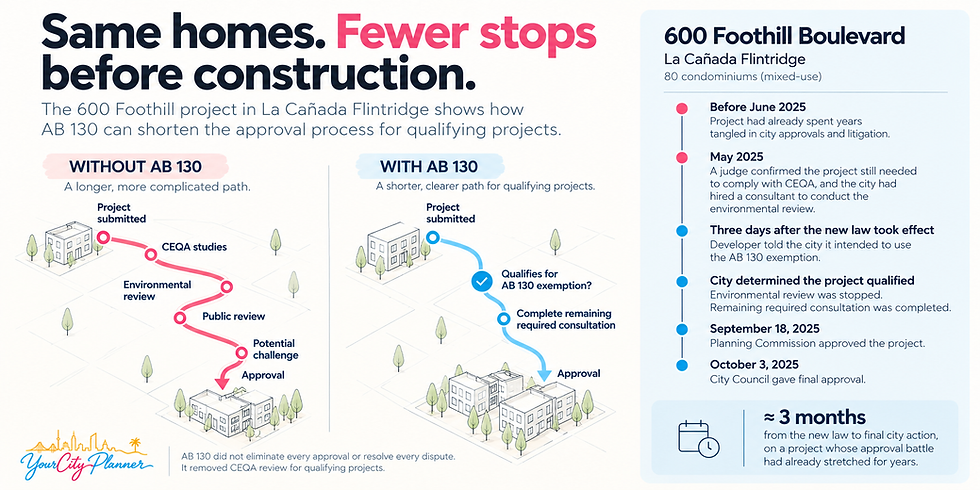
The 600 Foothill Boulevard project in La Cañada Flintridge gives us an even more dramatic example. The 80-condominium mixed-use project had already spent years tangled in city approvals and litigation. As recently as May 2025, a judge confirmed that the project still needed to comply with CEQA, and the city had hired a consultant to conduct the environmental review.
Then AB 130 arrived. Three days after the new law took effect, the developer told the city it intended to use the exemption. The city determined the project qualified, stopped the environmental review already underway, completed the remaining required consultation and moved the project forward. The Planning Commission acted in September, followed by final City Council action in October. That's roughly three months from AB 130 taking effect to final city action on a project whose larger approval battle had already stretched for years.
Without AB 130, we know at least one thing: the environmental review would have continued. That could have meant additional months of studies and public review, and potentially another opportunity for litigation. AB 130 didn't erase every disagreement surrounding the project. It essentially told everyone: you can stop arguing about this particular part now.
So why should someone trying to afford a home care about any of this? Because waiting isn't free.
Imagine a developer has $10 million tied up in land and other early project costs and is paying an illustrative 8% annual cost to finance that money. Another year could mean roughly $800,000 in additional financing costs before accounting for lawyers, consultants or rising construction prices. For a 200-home rental project, that's about $4,000 per home. For 25 townhomes, it's about $32,000 per home. Those numbers are only an illustration, not an estimate of what AB 130 actually saves. But they show why shaving months off an approval process can matter.
The math also works a little differently depending on the type of home. For rental homes, faster approvals can mean fewer months paying interest before residents move in and rent starts coming through the door. For homes being sold, those development costs ultimately have to be recovered through the sale of the individual homes.
Now, don't start subtracting $32,000 from the Zillow listing just yet. Developers don't automatically hand every dollar saved to the future renter or buyer. Savings might make a project financially possible, offset higher construction or borrowing costs, increase the developer's return or, when enough projects compete for residents and buyers, contribute to lower rents and prices.
But that's precisely why these reforms matter.
Mortgage rates aren't something California can simply vote lower. Neither is the price of lumber, concrete or labor. But California does control a lot of the rules for getting permission to build a home. And with homes already expensive and borrowing money getting more expensive, Sacramento has apparently decided that's a pretty good place to start looking for savings.
Curious what “moderate income” means where you live? It changes by county and household size. California's Department of Housing and Community Development publishes current income limits so you can look up your own area.