
Beyond the Final Whistle: What Makes a FIFA World Cup Worth Hosting?
In the spring of 2012, I found myself walking through a favela in Rio de Janeiro with a group of graduate students from Columbia University. The World Cup was still two years away. The Olympics were four years away. Construction cranes dotted the skyline, ambitious plans filled presentation boards, and from everything we had read about the plans Rio had there was an undeniable sense that Rio was on the verge of something extraordinary.
I wasn’t there as a tourist. I was a graduate school teaching assistant for our urban planning studio, whose client was Rio’s housing department. Our team was tasked with studying how the upcoming World Cup and Olympics could reshape neighborhoods, particularly around Porto Maravilha, where decades of disinvestment were giving way to one of the city’s most ambitious redevelopment efforts.
Ironically, for a planning studio centered on the World Cup and the Olympics, I don't remember us spending much time talking about soccer or any other Olympic sport. Our sport was observing the city. Somewhere between meetings, neighborhood visits, and late-night planning debates, I even got to practice my "Portuñol" with cab drivers, waiters, and bartenders. Looking back, I realize I wasn't just learning about Rio. I was learning how to see a city.
One of my favorite things to do is simply walking around cities. Not to check landmarks off a list, but to notice how they work. I find myself paying attention to the things most people walk right past: how people move through a street, why one plaza is full while another sits empty, how buses connect neighborhoods, or how the feeling of a place can completely change within a few blocks. It is probably the urban planner in me, but I’ve come to realize that every city has something to teach you if you are willing to slow down and look.
As we talked with residents, visited neighborhoods, and debated ideas late into the evening, one question kept resurfacing: would the city actually be better off after the world went home?
That question wasn’t unique to Rio. It was one our professors challenged us with throughout graduate school. No matter how exciting the proposal, how ambitious the design, or how impressive the numbers, we were always pushed to ask the same thing: so what...will the city be better off?
It sounds like a simple question, but I’ve come to realize it is one of the hardest questions in city planning. Hosting a global event like the World Cup is not just about stadiums or ticket sales. It is about housing, transportation, public safety, tourism, local businesses, public spaces, and thousands of decisions that determine whether one extraordinary month leaves behind something that improves everyday life for the people who call the city home.
Years later, that same question came back to me as I watched the United States, Mexico, and Canada host the 2026 FIFA World Cup. Only this time, something felt different. Instead of asking, What are these countries building? I found myself asking, Why aren’t they building very much at all?
The answer, I believe, says a great deal about how cities have evolved and perhaps even more about what we have learned from hosting mega-events over the last two decades.
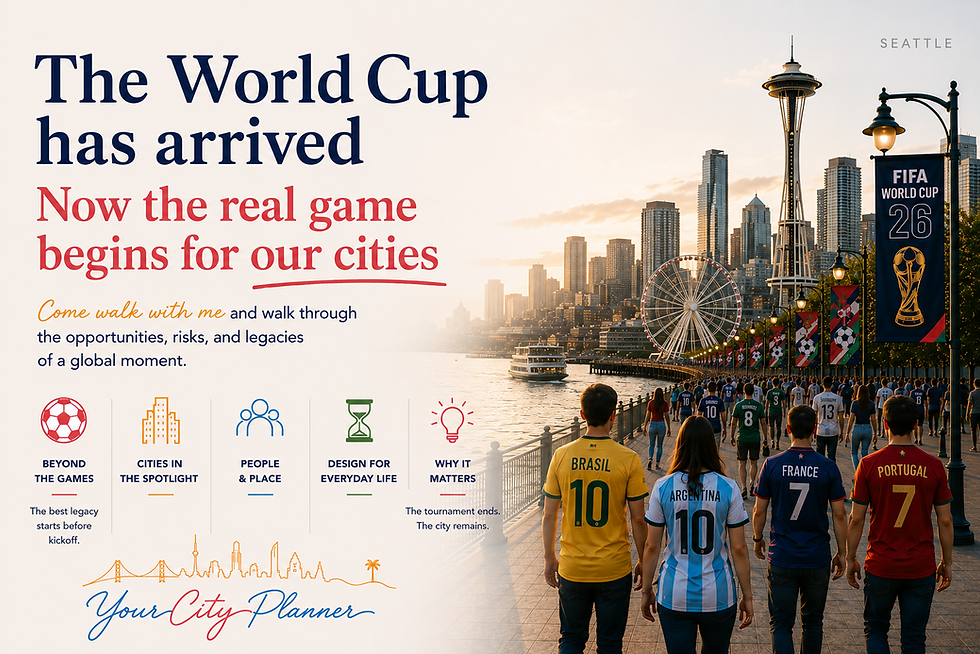
Bigger Isn’t Always Better
It is easy to forget the mindset of the early 2010s. Back then, hosting the World Cup or the Olympics often felt like winning the lottery. Cities competed aggressively because the prevailing belief was that these events would put them on the global map, attract investment, and accelerate long-awaited infrastructure projects.
The formula seemed straightforward. Build the stadiums. Expand the airport. Extend the transit system. Construct athlete villages. Beautify the city. The economic benefits would follow.
Of course, reality proved far more complicated. Some investments transformed cities for the better. Others became cautionary tales. Many sparked debates that continue today about public spending, housing displacement, and whether the promised economic benefits ever fully materialized.
Our studio wasn't trying to determine whether Brazil should host the World Cup. We were asking something much more practical. If billions of dollars are about to be invested in a city anyway, how can those investments leave residents better off long after the final match is played?
Looking back, I realize we were really asking a broader question that applies to almost every major public investment: who is all of this ultimately for?
A Different Kind of World Cup
The more I paid attention to how the United States, Mexico, and Canada were preparing for the 2026 World Cup, the more I realized this tournament is not defined by what was built. It is defined by what already existed.
That may sound obvious, but it is actually a remarkable shift.
Think about the iconic images from previous World Cups and Olympic Games. Brand new stadiums. Massive athlete villages. Entire districts transformed seemingly overnight. Whether those investments proved worthwhile is another conversation, but they were impossible to miss.
This time, many of the biggest investments are almost invisible. They are happening in airports, transit systems, emergency operations centers, digital wayfinding, security coordination, hotels, and fan festivals.
One thing that genuinely surprised me was seeing fan festivals pop up in cities that were not hosting a single match. At first, I found myself wondering why. Then it clicked. The World Cup was not just arriving in sixteen host cities. It was rippling across three entire countries.
A friend recently told me his annual guys’ trip to Las Vegas looked completely different this year. Instead of planning around late-night clubs, his group was planning around kickoff times. Day drinking had become central to their itinerary.
It is a funny observation, but it illustrates something planners sometimes overlook. Mega-events do not just reshape skylines. They reshape how cities are used.

Perhaps the biggest difference between Rio and 2026 is not infrastructure at all. It is complexity.
In Rio, much of the complexity centered on physical transformation. How do you finance, design, approve, and build massive infrastructure projects in time for the world to arrive?
In 2026, the infrastructure largely already exists. Now the challenge is operational. Can airports, transit agencies, police departments, emergency responders, volunteers, hotels, technology systems, and local businesses all operate as one coordinated network across three countries?
As someone who now spends much of my professional life bringing organizations together around shared goals, I have to admit I find that challenge fascinating. Building a stadium is incredibly difficult. But honestly, building the stadium might have been the easier part.

Three Countries. Three Different Lessons.
One of the things I did not appreciate at first is that this is not one host country. It is three. Each one seems to be teaching us something different about what it means to host a mega-event in 2026.
The United States is perhaps the easiest place to see this evolution. It is not really hosting one World Cup. It is hosting eleven different versions of it: Atlanta, Boston, Dallas, Houston, Kansas City, Los Angeles, Miami, New York/New Jersey, Philadelphia, San Francisco Bay Area, and Seattle.
Each host city has its own personality, transportation network, climate, governance structure, tourism economy, and fan culture. Yet somehow they all have to feel like they are part of the same tournament. That is an extraordinary coordination challenge.
It is also a reminder that a country’s greatest infrastructure asset is not always a stadium or a highway. Sometimes it is the ability to get hundreds of organizations moving in the same direction.
As anyone who has worked across multiple organizations knows, that is easier said than done. Everyone loves collaboration until someone sends the calendar invite.
Mexico tells a different story. Rather than asking, What should we build? The question seems to be, How do we honor what we already have while preparing for what comes next? There is something refreshing about that. Cities do not always have to reinvent themselves. Sometimes they simply need to evolve.
Canada offers yet another lesson. Hosting a World Cup has become as much about demonstrating fiscal discipline and long-term thinking as it is about putting on a spectacular event.
That shift feels significant. Not long ago, cities competed by announcing the biggest projects. Today, they are increasingly expected to explain something much less glamorous: how will this investment improve life after the tournament?
Ironically, that is often the harder sell.
What We Don’t See
A great tournament experience can feel effortless from the outside. Fans arrive, follow signs, board trains, find food, celebrate in plazas, and make it home safely. If everything works, most people never stop to think about how much coordination made that experience possible.
But behind that ease is a web of agencies, businesses, workers, volunteers, technology systems, and public decisions that have to align in real time. Airports have to absorb visitors. Transit agencies have to adjust service. Police and emergency responders have to coordinate across jurisdictions. Hotels, restaurants, small businesses, and fan zones all become part of the city’s operating system.
That is the part of mega-events I find most interesting now. Not just the spectacle, but the choreography behind it.

Cities Succeed Because of Everyday Moments
Over the years, I have come to believe that cities do not succeed because of ribbon cuttings. They succeed because of how people experience them every day.
Ribbon cuttings are exciting because they are tangible. You can point to a new station, a new stadium, or a new civic building. They are photogenic, easy to celebrate, and much easier to raise money for.
The harder work begins after everyone goes home. Maintaining those assets. Training staff. Updating technology. Strengthening coordination between agencies. Making sure thousands of small operational details continue working year after year.
No mayor proudly cuts a ribbon to celebrate better interagency communication. No commemorative plaque honors decades of preventative maintenance. And yet those investments are often the reason a city feels safe, efficient, and welcoming.
So How Will We Know If Cities Were Better Off?
After all these years, I keep coming back to the same question we asked in Rio. Will the city be better off?
The funny thing about asking whether a city is “better off” is that you cannot really answer it when the tournament ends. In fact, that is probably the worst possible time to ask.
The confetti is still being swept off the streets, hotels are reporting record occupancy, restaurants are celebrating their busiest month of the year, and everyone is still riding the emotional high of hosting the world. Of course everything feels like a success.
But that was not the question we were trying to answer in Rio, and it is not the question I am asking today. The question was never whether the World Cup would create an unforgettable month. The question was whether it would create a better city.
And that answer takes time.
The real evaluation does not begin until life returns to normal. The volunteers go back to their day jobs, the fan festivals disappear, the television cameras leave, and visitors head home. That is when you begin to see whether all of those investments changed anything for the people who never bought a ticket in the first place.
Does the train arrive a little more reliably on a rainy Tuesday morning? Do families still enjoy the public spaces that were activated during the tournament? Did local businesses build new relationships that continue long after the final whistle? Did governments learn how to collaborate a little better the next time a crisis, or an opportunity, come along?
Those are not the kinds of stories that make the evening news. But they might be the ones that matter most.
Looking Beyond the Final Whistle
I still keep in touch with several friends from that Columbia planning studio, and every once in a while I catch myself wondering what would happen if we all met back in Rio.
Would we think the city is better off? Would we notice things we completely missed in 2012? Would we ask different questions now that we have spent another fourteen years learning how cities really work? Or would we realize that our original question was the right one all along?
One of the first lessons I learned in graduate school was that every planning project eventually comes back to the same question: so what...will the city be better off?
Years later, I still find myself asking it.
As I watch the United States, Mexico, and Canada host the 2026 World Cup, I am optimistic. Not because the tournament appears bigger than those that came before it, but because it feels wiser.
The conversation has evolved. Yes, there are still stadiums to fill, visitors to welcome, and billions of dollars to account for. But there also seems to be a growing recognition that the true measure of success is not what we build for a month. It is what continues to serve people long after the tournament ends.
Maybe that is what maturity looks like for cities. Less focused on creating monuments. More focused on creating systems that quietly improve everyday life. As someone who loves watching cities evolve, I'm genuinely curious to see what happens next. Years ago, I walked the streets of Rio wondering whether the city would be better off after the world went home. Today, I find myself asking the same question as planning continues for the next FIFA World Cup 2030 across Morocco, Spain, and Portugal. The cities are different. The context is different. But the question remains the same. It'll be fascinating to see which lessons carry forward and what new ones emerge.
Cities are not judged by how they perform during extraordinary moments. They are judged by how they serve people once ordinary life returns.
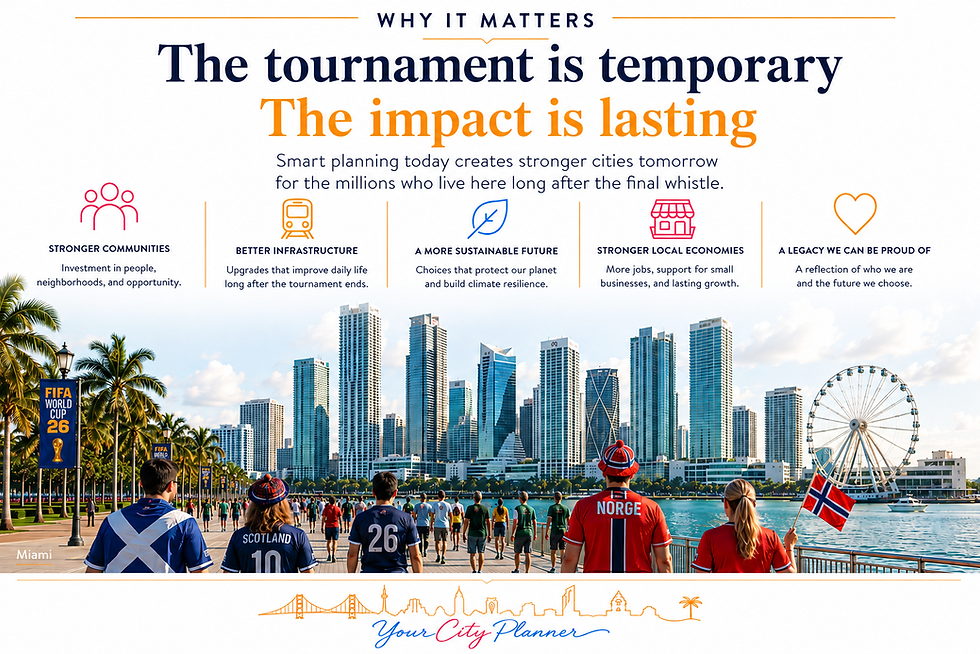
The World Cup moves on. The city doesn’t.


