top of page

Essays

Inspirations Blog: Headliner

Making sense of the systems, decisions, and designs that shape city life

Inspirations Blog: Blog2

Cities shape our daily lives in ways we often take for granted. A sidewalk that suddenly feels too narrow. A commute that changes without explanation. A neighborhood that evolves faster than anyone expected. These moments are rarely accidental. They are the result of policies, planning decisions, infrastructure investments, and increasingly, digital systems guiding how cities operate.

The Essays take a closer look at those forces. They combine firsthand observation from cities with policy and systems analysis to explore how places grow, adapt, and sometimes get it wrong. Topics range from urban design and transportation to governance, infrastructure, and the emerging role of artificial intelligence and digital twins in city decision-making.

This writing is meant for curious readers, not specialists. You do not need a planning background to follow along. The goal is to make the systems behind urban life more legible, to ask better questions about how cities are built, and to understand how today’s decisions quietly shape the places we will live in tomorrow.

There is a recurring assumption among investors and technologists that municipal AI initiatives could limit private-sector upside. The logic goes like this: if cities build digital twins and AI platforms, they may internalize capabilities that companies would otherwise sell. This belief surfaces less in public critique than in behavior. Particularly in capital allocation, where city-facing AI deployments are often discounted as slow-moving, low-margin, or primarily reputational rather than revenue-generating.


Miami proves the opposite. And it is not alone.


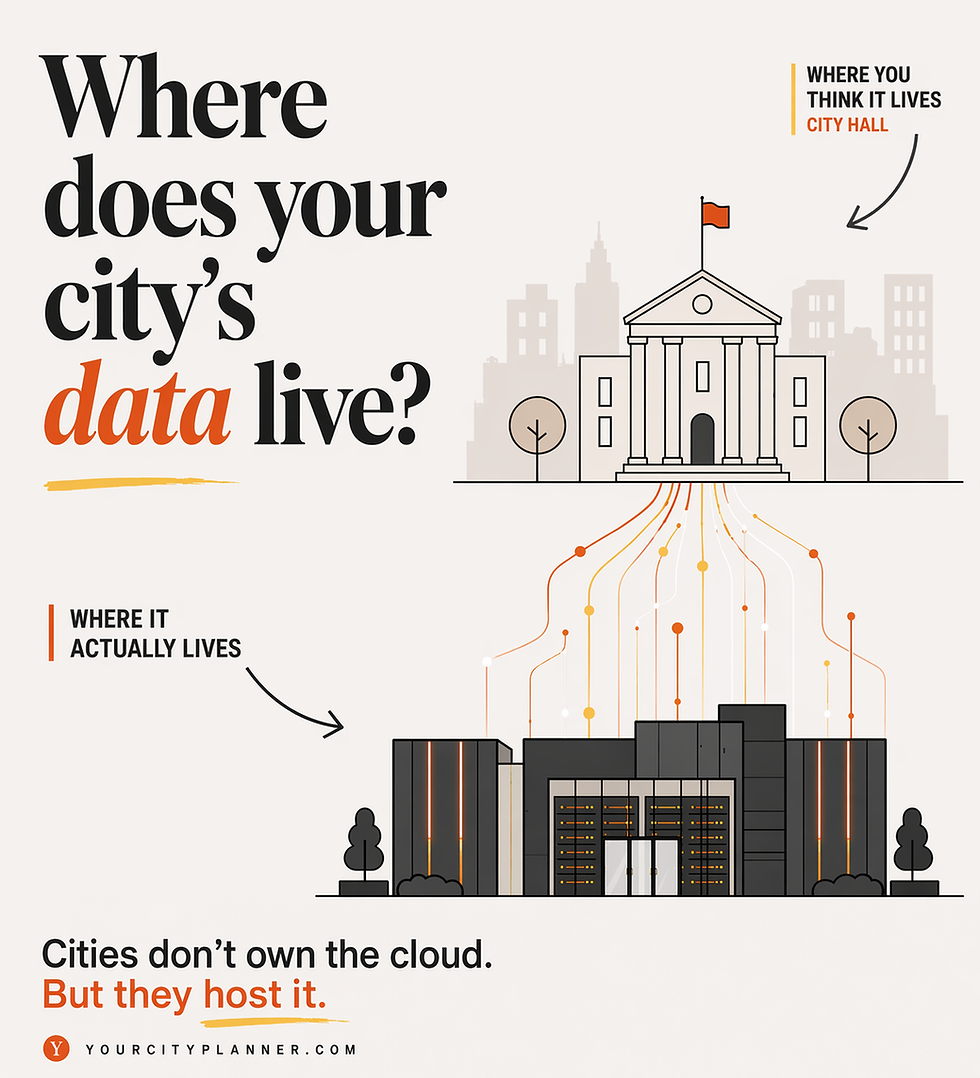
Across the country, and increasingly globally, cities are beginning to play a similar role: not as AI builders, but as hosts and anchor customers for compute-intensive systems that must operate in real-world conditions.


Cities Live at the Application Layer

Miami’s Brickell AI Digital Twin sits alongside a growing cohort of city-led AI deployments that share a common structure, even if their use cases differ.


New York City uses AI-driven modeling for energy benchmarking, building performance, and climate risk analysis across its dense real estate portfolio.


Los Angeles deploys AI for traffic optimization, wildfire risk modeling, and port logistics; all systems that require continuous inference and simulation.


Chicago has invested in urban sensing and predictive analytics for infrastructure maintenance and public health.


Singapore operates one of the most advanced national-scale digital twin initiatives, Virtual Singapore, designed to simulate mobility, energy use, and climate impacts.


In every case, the pattern is the same: cities define the problem space and provide access to real-world constraints, while private companies supply the models, compute, and physical infrastructure.


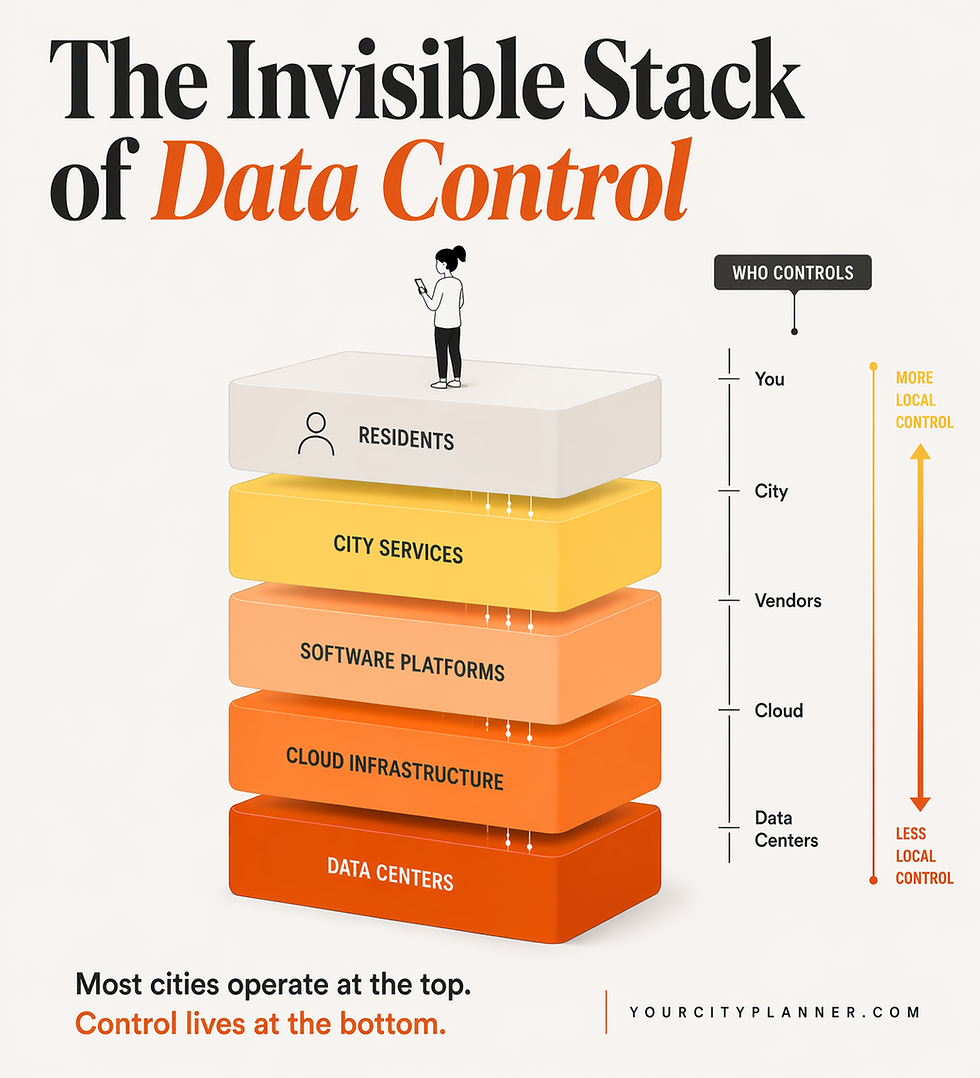
The AI stack is not abstract; it is hierarchical.

  • At the top sit use cases: traffic optimization, climate resilience, zoning simulation. Cities live here.

  • Below that sit models and platforms: computer vision, simulation engines, predictive analytics.

  • Below that is compute demand: training, inference, real-time simulation.

  • At the bottom is physical infrastructure: data centers, power, cooling, interconnect.


Cities do not descend this stack. They activate it.


Every new city use case increases compute demand. Every persistent digital twin creates permanent workloads. These are not bursty experiments. They are 24/7 systems.


Why City AI Grows the Market, Not Shrinks It

Before city adoption, AI demand was largely discretionary around enterprise optimization, consumer features, and experimental tools.


City adoption introduces:

  • Non-discretionary workloads

  • Public safety use cases

  • Climate resilience mandates

  • Politically durable budgets


This is the kind of demand infrastructure markets are built on.


Companies that own or operate data centers, power infrastructure, and high-density compute benefit when AI escapes the lab and embeds itself into civic systems. These workloads are sticky, long-lived, and difficult to migrate.


Cities Cannot Vertically Integrate

Even if a city wanted to internalize AI infrastructure, it would fail. Cities cannot:

  • Manufacture GPUs

  • Operate hyperscale data centers

  • Solve cooling at scale

  • Secure long-term power contracts


They are structurally incapable and it is not their core business model.


This is not a weakness. It is a guarantee.


Infrastructure providers are protected by physics, capital intensity, and institutional mismatch. Cities will always consume, not compete.


The Only Real Constraint: Power

If there is a risk to this model, it is not saturation; it is bottlenecks. Power availability, grid constraints, and permitting delays can slow deployment.


That is why energy-adjacent infrastructure like nuclear, small modular reactors, and advanced cooling emerges as a downstream beneficiary of city AI.


When AI becomes civic infrastructure, energy becomes strategic.


What This Means for Cities and the AI Market

This is why city–AI partnerships deserve sustained, component-level analysis rather than one-off hype cycles. Governance incentives, capital flows, infrastructure economics, energy systems, and regulatory leverage each operate on different timelines; and each warrants its own examination.


Miami’s AI Digital Twin does not compress margins or crowd out private innovation. It does the opposite: it expands the surface area of demand by turning urban systems into continuous, real-world AI workloads.


Cities are becoming one of the most consequential customer classes in AI not because they invent technology, but because they make its deployment unavoidable and durable.


Miami recognized this early. A growing number of cities are now stepping into the same role: host, amplifier, and long-term customer.


That is why the future of AI will not be built only in labs or data centers. It will be negotiated, tested, and proven in cities willing to open their doors.

On a recent visit to Playa del Carmen, I found myself locked in a battle not with the sun, surf, or sargassum—but with a parking meter. What should have been a simple transaction—just 10 pesos (about 60 cents) for an hour of street parking—turned into a 30-minute odyssey of glitchy tech, confusing bureaucracy, and a tourism strategy that increasingly feels less about welcoming visitors and more about squeezing them.


The parking meters in downtown Playa, in theory, reflect a modern, urban upgrade. Each sleek silver machine boasts multilingual instructions and logos suggesting compatibility with credit cards and mobile apps. In practice, however, they are the bureaucratic equivalent of a mirage.


Despite the signage, none of the machines I encountered accepted credit cards. Mexican coins only. And who carries a fistful of coins in 2025, let alone in pesos? When I turned to the mobile app—standard in most global cities—I found myself locked out. The app refused to create an account, and even the “Help” section came with a catch: I’d need to sign up for a monthly subscription just to access assistance. That’s right—25 pesos a month (cancel anytime, if you remember), just for the privilege of being told how to pay for parking.


Hoping for a workaround, I ducked into Porfirio’s Restaurant, a well-known spot a few steps away from my car. The hostess, who spoke with a clear Argentinian accent, nodded knowingly when I explained my situation. “Sí, solo monedas,” she said—only coins. Then, with a sympathetic glance, she added, “Si no pagas, te ponen el candado.” If you don’t pay, they’ll clamp your tire with a metal device that immobilizes the car—similar to a Denver boot. I assumed that meant hours later, or maybe overnight. Surely there was a grace period while I tried to find change?


Apparently not.


As I returned to my rental car to continue the coin search, I saw a small team of uniformed city employees working their way down the street, locking wheels and slapping fluorescent stickers onto windshields. Tourists hovered nearby, confused and distressed. One officer kindly listened as I explained my failed attempts to pay, my screenshots, my effort. He handed me a laminated placard—the kind left on vehicles after they’ve been immobilized—and said I could “try calling the number” on the back. That’s the same number drivers must dial after paying a 580-peso fine (roughly $35 USD) at the municipal treasury or an Oxxo convenience store.


The message was clear: this isn’t about managing limited parking space. This is about trapping people—locals and tourists alike—in a system engineered for failure, then charging them for the privilege of trying.


Eventually, one of the enforcement staff took pity and pointed me to a paid lot at a nearby mall. Grateful, I parked and went about my night. But the saga wasn’t over. When it came time to leave, the payment machines inside the lot also refused credit cards and declined large bills. Dollar payments were accepted only by a human attendant—who was nowhere to be found. I wandered the lot and eventually found him chatting with security guards inside the mall. I speak Spanish. I found him by luck. But what about the average tourist?


A Parking System Designed for Confusion

The parking meter system in Playa del Carmen was introduced in December 2019 under a 15-year concession to a company called Promotora de Reordenamiento Urbano S.A. de C.V., operating under the brand name Playa Parq and using the Mueve Ciudad app. But as mentioned earlier, the app refused to create an account and even locked customer support behind a monthly 25-peso subscription—just to ask a question. Which begs the question: is this just a tourist Inconvenience, or was the system designed to fail by making it deliberately hard to pay for parking?


Since its implementation, the system has generated significant revenue. From 2021 to 2024, meters and fines have brought in more than 60 million pesos, and in 2025 alone, the projected revenue is 38 million pesos. That’s not counting what’s collected through towing and immobilization fees.


Despite this financial windfall, the user experience remains dire. The app is available only in Spanish. There’s no easy way for international visitors to understand the process, no signage explaining how long one can park before being clamped, and no personnel trained to support confused tourists. Just an assumption that you know how it all works—and consequences if you don’t.


Designing for Accessibility

Playa del Carmen is one of the jewels of the Riviera Maya—an international destination that prides itself on its hospitality. Boutique hotels, luxury condos, eco-parks, and a famously walkable downtown draw millions of visitors a year. But the city’s parking system is a Kafkaesque experience that seems intentionally opaque, with malfunctioning apps, contradictory instructions, and payment systems built for maximum inconvenience.

It doesn’t have to be this way. If Playa truly wants to welcome visitors, it must design a parking system that’s user-friendly, multilingual, and accessible. That means functional card readers, working apps, non-predatory fines, and customer service that doesn’t require a subscription. 


In the meantime if you’re planning a trip to Playa del Carmen, here’s a travel tip: pack pesos, patience, and perhaps a little luck when it comes to parking.


Otherwise, Playa del Carmen risks sending tourists the message that paradise is only accessible—if you can figure out how to park.


The devastating wildfires of 2025 have scarred Los Angeles, displacing tens of thousands, destroying countless homes, and reducing over 50,000 acres to ash. Since the fires began on January 7th, residents have faced unimaginable loss. But amid the smoldering ruins lies an opportunity for transformation—one that calls for leadership, not lip service.


This is not just about rebuilding; it’s about reimagining. Los Angeles must seize this moment to address systemic vulnerabilities, create fire-resilient communities, and ensure no Angeleno is left behind. Anything less would be a betrayal of those who have already lost so much.


The Danger Persists: Prioritize Safety First

While the fires are now contained, the crisis is far from over. Smoldering hotspots, gas leaks, and damaged infrastructure pose ongoing risks. Emergency crews—firefighters, engineers, and utility workers—are racing to stabilize affected areas, but patience is critical to avoid further tragedies. The County of Los Angeles, in collaboration with CAL FIRE, has developed preliminary maps detailing damage assessments from the Palisades and Eaton fires, with updates being made daily to reflect the evolving situation.


Governor Gavin Newsom and FEMA have pledged to cover 100% debris removal costs for the first 180 days, a step that ensures safer rebuilding conditions. But local leaders, including the Mayor of Los Angeles, Karen Bass, must ensure that short-term safety measures transition into long-term planning for resilience.


Cutting Red Tape: A Double-Edged Sword

Streamlining permits for rebuilding homes, as promised by Mayor Bass and the Mayor of Malibu, Doug Stewart, may seem like an effective solution. However, fast-tracking approvals without robust oversight risks repeating past mistakes. We cannot afford to rebuild homes that will become tinderboxes in the next wildfire.


The focus must be on fire-resistant designs and updated building codes. Pre-approved templates using materials like metal roofing, tempered glass, and non-flammable siding can expedite construction while ensuring safety. Governor Newsom’s reforms to simplify the permitting process must balance urgency with accountability.


A Resilient Recovery: The 100-Day Plan

The first 100 days after a disaster are critical to shaping recovery. Here’s how Los Angeles can lead the way:


  • Debris Removal and Recycling: Collaborate with CalRecycle and the U.S. Army Corps of Engineers to turn waste into resources. Salvaged metal can be reused, charred wood converted into mulch, and concrete crushed for infrastructure projects.

  • Temporary Housing Solutions: Modular homes and RV parks on public lands can provide safe shelter for displaced families.

  • Fire-Resilient Infrastructure: Repair roads, bury power lines in high-risk areas, and expand vegetation management zones. Early detection systems must be prioritized to prevent future disasters.

  • Environmental Restoration: Restore natural landscapes by planting fire-resistant native vegetation that reduces the spread of wildfires, improves soil health, and supports local ecosystems, creating a natural barrier against future disasters.

  • Support for Small Businesses: Grants and zero-interest loans can help businesses reopen, while local campaigns like “Shop Local LA” can stimulate the economy.

  • Updated Building Codes: Financial assistance for low-income homeowners to rebuild with fire-resistant materials can ensure equitable recovery.


Leadership Under Scrutiny

Mayor Karen Bass has faced sharp criticism for what many Angelenos see as a slow and reactive response to the crisis, leaving vulnerable communities feeling abandoned during their time of greatest need. Her recent pledges to cut red tape and expedite recovery efforts ring hollow for those still waiting to be able to see what's left of their homes and clear communication of when rebuilding can start. The perception of delay has amplified frustration, raising questions about her administration's preparedness for managing large-scale emergencies.


Governor Newsom, while proactive in mobilizing state resources, has not escaped scrutiny from Trump. President Donald Trump’s sharp criticism of California’s wildfire management has done little to foster collaboration. Newsom’s invitation for Trump to tour the affected areas, offered a rare glimpse of political opposites navigating a crisis. Trump, known for his sharp critiques of California’s environmental policies, surprised many during his January 24, 2025 visit to Los Angeles by striking a conciliatory tone. Trump promised to waive federal permitting requirements and pledged full federal support for recovery efforts. The visit, which began with a symbolic tarmac handshake, evolved into a careful dance of mutual need. For Newsom, who had fiercely opposed Trump on numerous issues, this was an opportunity to secure resources for a state ravaged by disaster. For Trump, it was a stage to project statesmanship while subtly reinforcing his critiques of California’s policies.


But as Angelenos sift through the ashes of their communities, political rivalries and photo ops provide little comfort. What they need is coordinated action and swift, tangible support. The success of the recovery effort hinges on leaders prioritizing solutions over sound bites, setting aside ideological differences to deliver results where they are most urgently needed.


Community Resilience: Stories That Inspire

Amid the devastation, stories of resilience are emerging. In working-class neighborhoods often overshadowed by media focus on celebrity homes, families have lost everything—yet they’re leading grassroots recovery efforts. Volunteer groups are clearing debris, distributing supplies, and offering temporary shelter.


Organizations like the Red Cross, local nonprofits, and businesses have stepped up, providing discounted hotel stays and emergency assistance. Neighbors are opening their homes and hearts, embodying the spirit of unity that will drive LA’s recovery.


A Call to Action

The 2025 wildfires have exposed the fragility of Los Angeles’s infrastructure, policies, and leadership. But they’ve also revealed the strength of its people. Rebuilding is not just about replacing what was lost; it’s about addressing systemic issues and ensuring a tragedy like this never happens again.


The road ahead is steep. With over $800 billion in economic activity at risk countywide, bold, decisive action is not optional—it’s essential. Leaders must act with urgency, transparency, and accountability. And Angelenos must remain engaged, whether by volunteering, advocating for resilience policies, or simply supporting neighbors in need.


The stakes couldn’t be higher. This is a test of a collective will to rebuild stronger, smarter, and more equitably. Los Angeles has a chance to rise from the ashes—not just as a city that survived, but as one that leads the way in disaster resilience and recovery. Let’s not waste it.


Now is the time for action. Southern Californians deserve nothing less.


Interested in writing, speaking, or advisory collaborations?

Thanks for reaching out!

copyright © 2026 | Your City Planner | all rights reserved  

www.yourcityplanner.com

bottom of page