The AI Boomtown Race
Updated: Mar 31
Across America, cities are competing to host the infrastructure that powers artificial intelligence.
Abilene isn’t the only city chasing the AI boom.
Across the United States, communities from the high plains of Wyoming to the manufacturing corridors of Ohio are positioning themselves as hubs for the next generation of digital infrastructure. Local leaders increasingly see AI data centers as the modern equivalent of railroads or factories that, while they require massive upfront investments, also have the power to anchor regional economies for decades.
But the new infrastructure economy comes with a twist. Artificial intelligence facilities require extraordinary amounts of electricity, land, and fiber connectivity, while employing far fewer workers than the industrial plants many communities once depended on.
For cities hoping to become AI boomtowns, the rewards, and the risks, are coming into focus.

Cheyenne, Wyoming: Power on the High Plains
Cheyenne, the capital of Wyoming, has quietly become one of the country’s more strategic locations for digital infrastructure.
Over the past decade, the region has attracted a series of major data center investments, beginning with large campuses developed by Microsoft. The appeal is straightforward: abundant energy, inexpensive land, and proximity to long-haul fiber routes that follow major interstate corridors across the western United States.
Wyoming’s energy resources have been particularly important. The state produces far more electricity than it consumes, thanks to its mix of wind generation and traditional power plants. For hyperscale operators building facilities that can draw hundreds of megawatts, that surplus matters.
Like many modern data center campuses, the facilities outside Cheyenne are physically large but operationally quiet. Once construction crews leave, a campus that may cost billions of dollars can operate with only a few hundred technicians and engineers.
For Wyoming officials, the calculation is less about employment than about long-term tax revenue and positioning the state within the infrastructure economy that underpins cloud computing and artificial intelligence.
Mesa, Arizona: Silicon Desert
Outside Phoenix, the desert has become one of the fastest-growing digital infrastructure markets in the country.
Mesa and the broader Phoenix metropolitan region now host dozens of data centers, with estimates suggesting more than 70 facilities and roughly 20 million square feet of data center space across the region.
Arizona’s growth reflects a powerful convergence of forces. Massive semiconductor investments, including fabrication plants from companies such as TSMC and Intel, have turned the Phoenix area into one of North America’s most important technology manufacturing hubs.
Data centers naturally follow.
AI systems require enormous computing power, which in turn depends on the same semiconductor supply chains and engineering ecosystems that support advanced chip manufacturing. The result is an increasingly dense technology cluster stretching across the desert.
What has emerged is less a single campus than a regional infrastructure network. A digital backbone supporting artificial intelligence, cloud computing, and advanced manufacturing.
Ashburn, Virginia: The Internet’s Capital
If any place represents the center of the global data center industry, it is Ashburn, Virginia.
Located in Loudoun County outside Washington, D.C., the region has become the world’s largest concentration of data centers, with more than 300 facilities and an estimated 30 million square feet of server space.
A significant share of the world’s internet traffic passes through fiber exchanges located in Northern Virginia, making the region one of the most important digital crossroads on the planet.
Unlike newer AI infrastructure hubs, Ashburn’s rise was not the result of a single economic development strategy. Instead, it grew gradually from its position as a telecommunications nexus during the early expansion of the commercial internet.
Today, hyperscale operators including Amazon Web Services, Google, and Microsoft operate massive campuses across the region.
But the very success of Northern Virginia’s data center industry has created new tensions. Electricity demand has surged, forcing utilities and regulators to confront a difficult question: how quickly can the power grid expand to support the next generation of AI computing?

Columbus, Ohio: The Midwest AI Corridor
In central Ohio, a different model is emerging.
Columbus has become one of the fastest-growing technology markets in the Midwest, fueled in part by major investments from Amazon Web Services, Google, and Meta. Across the region, dozens of data centers are operating or under construction, contributing to a footprint estimated between 15 and 20 million square feet.
The region’s appeal lies partly in geography. Columbus sits within a day’s drive of major Midwestern population centers while offering relatively affordable land and reliable power infrastructure.
Workforce pipelines have also played a role. Institutions such as Ohio State University produce engineering and technical talent that helps support the growing technology sector.
State and local governments have aggressively pursued data center investment as part of a broader effort to reposition the Midwest within the digital economy.
For a region long associated with manufacturing, the infrastructure of artificial intelligence represents a new kind of industrial strategy.
Richmond County, North Carolina: The Rural Revival Bet
In rural North Carolina, the calculus looks different.
Communities like Richmond County see AI infrastructure as a potential successor to the manufacturing plants and textile mills that once anchored local economies, and have begun attracting investment from companies like Amazon.
Local officials have assembled large tracts of land and approved incentive packages designed to attract hyperscale development. The pitch is simple: affordable land, available power infrastructure, and a regulatory environment that allows projects to move quickly.
For many rural regions, the hope is that data centers can spark a new wave of investment.
But the economic model differs sharply from the factories these communities once depended on. Data centers bring massive capital spending during construction but relatively small permanent workforces once operations begin.
For local leaders, the promise often lies in long-term property tax revenue rather than job creation.
The Infrastructure Equation

Despite their geographic differences, the cities competing for AI investment share a remarkably similar formula.
Hyperscale data centers require three resources above all else: electricity, land, and fiber.
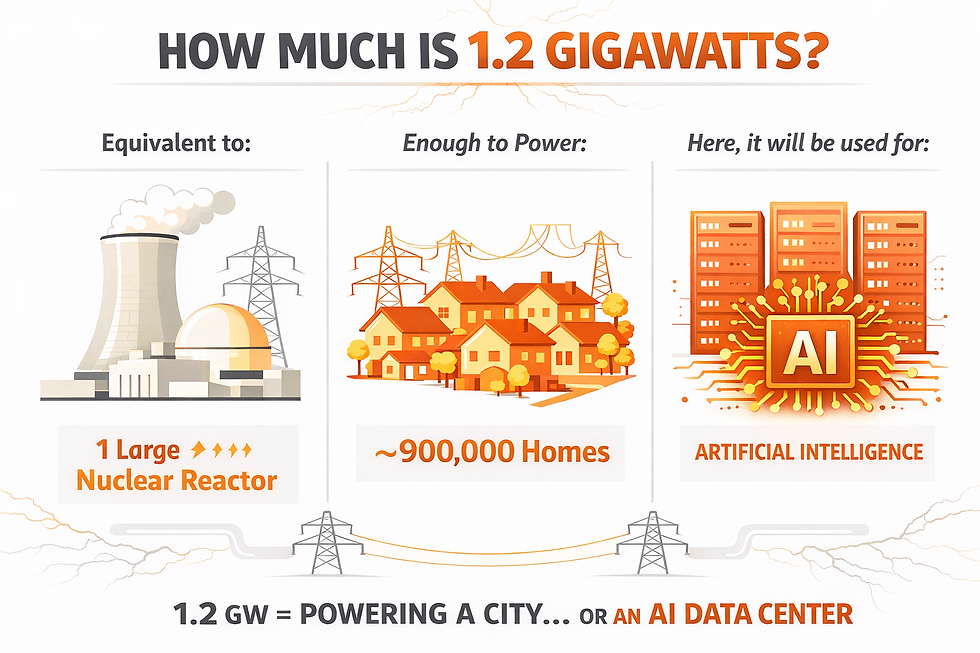
Electricity has become the most critical constraint. Modern AI training clusters can consume hundreds of megawatts of power, sometimes approaching the output of a large nuclear reactor. In many cases, utilities must build entirely new substations or transmission lines to support these facilities.

Land is the second requirement. AI campuses require large parcels to accommodate server halls, cooling systems, substations, and future expansion.
Fiber networks complete the equation. High-capacity connections are essential for linking AI systems to cloud platforms and global internet exchanges.
Local governments can accelerate permitting and offer tax incentives, but they cannot build power plants or fiber routes overnight. Increasingly, the pace of AI infrastructure development depends less on economic development strategy than on the physical limits of the electrical grid.
The Boomtown Question

Across the country, cities are racing to attract the infrastructure that will power artificial intelligence.
The investments are enormous. Individual campuses can cost billions of dollars and consume as much electricity as small cities.
Yet the economic equation differs from the industrial booms that once reshaped American towns.
Traditional factories often employed hundreds or thousands of workers. Hyperscale data centers typically operate with only a few hundred permanent staff once construction ends.
For many communities, the real promise lies in property tax revenue and the possibility of becoming a strategic node in the digital economy.
But the incentives used to attract these projects raise a deeper question.
If communities compete too aggressively by offering too large tax abatements and subsidies, then the public return on these investments becomes harder to measure.
In that sense, the rise of AI boomtowns may represent a new kind of economic gamble.
One defined less by assembly lines and smokestacks than by server racks, fiber cables, and transmission lines.
And yet the geography of the digital world is shifting.
Places once known for oil fields, rail yards, or farmland are becoming part of the physical backbone of artificial intelligence.
Whether these communities are witnessing the beginning of a durable infrastructure economy, or simply the latest chapter in America’s long history of boomtowns remains an open question.
But the map of where the future is being built is already changing.
And increasingly, it runs through places few people recognize, and far from the traditional centers of the technology industry.