top of page

ARTICLES

Inspirations Blog: Headliner

Most people experience cities without thinking much about the systems behind them. A train arrives on time. A neighborhood begins to change. A stadium fills with fans. A new technology quietly reshapes the way people move, pay, work, or connect. Those moments rarely happen by accident. Every article begins with a real observation and follows it back to the leadership, infrastructure, technology, economics, and public decisions that made it possible.

Inspirations Blog: Blog2
  • Mar 19
  • 5 min read

Across America, cities are competing to host the infrastructure that powers artificial intelligence.


Abilene isn’t the only city chasing the AI boom.


Across the United States, communities from the high plains of Wyoming to the manufacturing corridors of Ohio are positioning themselves as hubs for the next generation of digital infrastructure. Local leaders increasingly see AI data centers as the modern equivalent of railroads or factories that, while they require massive upfront investments, also have the power to anchor regional economies for decades.


But the new infrastructure economy comes with a twist. Artificial intelligence facilities require extraordinary amounts of electricity, land, and fiber connectivity, while employing far fewer workers than the industrial plants many communities once depended on.


For cities hoping to become AI boomtowns, the rewards, and the risks, are coming into focus.


Map of the United States highlighting key AI data center hubs including Abilene, Texas; Cheyenne, Wyoming; Mesa, Arizona; Ashburn, Virginia; Columbus, Ohio; and Richmond County, North Carolina, with icons showing electricity, fiber, land, workforce, and incentives.

Cheyenne, Wyoming: Power on the High Plains

Cheyenne, the capital of Wyoming, has quietly become one of the country’s more strategic locations for digital infrastructure.


Over the past decade, the region has attracted a series of major data center investments, beginning with large campuses developed by Microsoft. The appeal is straightforward: abundant energy, inexpensive land, and proximity to long-haul fiber routes that follow major interstate corridors across the western United States.


Wyoming’s energy resources have been particularly important. The state produces far more electricity than it consumes, thanks to its mix of wind generation and traditional power plants. For hyperscale operators building facilities that can draw hundreds of megawatts, that surplus matters.


Like many modern data center campuses, the facilities outside Cheyenne are physically large but operationally quiet. Once construction crews leave, a campus that may cost billions of dollars can operate with only a few hundred technicians and engineers.


For Wyoming officials, the calculation is less about employment than about long-term tax revenue and positioning the state within the infrastructure economy that underpins cloud computing and artificial intelligence.


Mesa, Arizona: Silicon Desert

Outside Phoenix, the desert has become one of the fastest-growing digital infrastructure markets in the country.


Mesa and the broader Phoenix metropolitan region now host dozens of data centers, with estimates suggesting more than 70 facilities and roughly 20 million square feet of data center space across the region.


Arizona’s growth reflects a powerful convergence of forces. Massive semiconductor investments, including fabrication plants from companies such as TSMC and Intel, have turned the Phoenix area into one of North America’s most important technology manufacturing hubs.


Data centers naturally follow.


AI systems require enormous computing power, which in turn depends on the same semiconductor supply chains and engineering ecosystems that support advanced chip manufacturing. The result is an increasingly dense technology cluster stretching across the desert.


What has emerged is less a single campus than a regional infrastructure network. A digital backbone supporting artificial intelligence, cloud computing, and advanced manufacturing.


Ashburn, Virginia: The Internet’s Capital

If any place represents the center of the global data center industry, it is Ashburn, Virginia.


Located in Loudoun County outside Washington, D.C., the region has become the world’s largest concentration of data centers, with more than 300 facilities and an estimated 30 million square feet of server space.


A significant share of the world’s internet traffic passes through fiber exchanges located in Northern Virginia, making the region one of the most important digital crossroads on the planet.


Unlike newer AI infrastructure hubs, Ashburn’s rise was not the result of a single economic development strategy. Instead, it grew gradually from its position as a telecommunications nexus during the early expansion of the commercial internet.


Today, hyperscale operators including Amazon Web Services, Google, and Microsoft operate massive campuses across the region.


But the very success of Northern Virginia’s data center industry has created new tensions. Electricity demand has surged, forcing utilities and regulators to confront a difficult question: how quickly can the power grid expand to support the next generation of AI computing?


Comparison chart of major AI data center regions showing number of facilities, estimated square footage, and key advantages across Abilene, Cheyenne, Mesa, Ashburn, Columbus, and Richmond County.

Columbus, Ohio: The Midwest AI Corridor

In central Ohio, a different model is emerging.


Columbus has become one of the fastest-growing technology markets in the Midwest, fueled in part by major investments from Amazon Web Services, Google, and Meta. Across the region, dozens of data centers are operating or under construction, contributing to a footprint estimated between 15 and 20 million square feet.


The region’s appeal lies partly in geography. Columbus sits within a day’s drive of major Midwestern population centers while offering relatively affordable land and reliable power infrastructure.


Workforce pipelines have also played a role. Institutions such as Ohio State University produce engineering and technical talent that helps support the growing technology sector.


State and local governments have aggressively pursued data center investment as part of a broader effort to reposition the Midwest within the digital economy.


For a region long associated with manufacturing, the infrastructure of artificial intelligence represents a new kind of industrial strategy.


Richmond County, North Carolina: The Rural Revival Bet

In rural North Carolina, the calculus looks different.


Communities like Richmond County see AI infrastructure as a potential successor to the manufacturing plants and textile mills that once anchored local economies, and have begun attracting investment from companies like Amazon.


Local officials have assembled large tracts of land and approved incentive packages designed to attract hyperscale development. The pitch is simple: affordable land, available power infrastructure, and a regulatory environment that allows projects to move quickly.


For many rural regions, the hope is that data centers can spark a new wave of investment.


But the economic model differs sharply from the factories these communities once depended on. Data centers bring massive capital spending during construction but relatively small permanent workforces once operations begin.


For local leaders, the promise often lies in long-term property tax revenue rather than job creation.


The Infrastructure Equation

Triangle diagram illustrating the core requirements of AI data centers: electricity, land, and fiber, converging to support hyperscale artificial intelligence infrastructure.

Despite their geographic differences, the cities competing for AI investment share a remarkably similar formula.


Hyperscale data centers require three resources above all else: electricity, land, and fiber.


Electricity has become the most critical constraint. Modern AI training clusters can consume hundreds of megawatts of power, sometimes approaching the output of a large nuclear reactor. In many cases, utilities must build entirely new substations or transmission lines to support these facilities.


Infographic comparing electricity demand of a hyperscale AI data center to a nuclear power plant, steel mill, and small city, showing that large data centers can consume up to 1.2 gigawatts of power.

Land is the second requirement. AI campuses require large parcels to accommodate server halls, cooling systems, substations, and future expansion.


Fiber networks complete the equation. High-capacity connections are essential for linking AI systems to cloud platforms and global internet exchanges.


Local governments can accelerate permitting and offer tax incentives, but they cannot build power plants or fiber routes overnight. Increasingly, the pace of AI infrastructure development depends less on economic development strategy than on the physical limits of the electrical grid.


The Boomtown Question

Side-by-side comparison of traditional manufacturing plants and hyperscale data centers showing job counts and wage ranges, highlighting fewer but higher-paid jobs in data centers.

Across the country, cities are racing to attract the infrastructure that will power artificial intelligence.


The investments are enormous. Individual campuses can cost billions of dollars and consume as much electricity as small cities.


Yet the economic equation differs from the industrial booms that once reshaped American towns.


Traditional factories often employed hundreds or thousands of workers. Hyperscale data centers typically operate with only a few hundred permanent staff once construction ends.


For many communities, the real promise lies in property tax revenue and the possibility of becoming a strategic node in the digital economy.


But the incentives used to attract these projects raise a deeper question.


If communities compete too aggressively by offering too large tax abatements and subsidies, then the public return on these investments becomes harder to measure.


In that sense, the rise of AI boomtowns may represent a new kind of economic gamble.


One defined less by assembly lines and smokestacks than by server racks, fiber cables, and transmission lines.


And yet the geography of the digital world is shifting.


Places once known for oil fields, rail yards, or farmland are becoming part of the physical backbone of artificial intelligence.


Whether these communities are witnessing the beginning of a durable infrastructure economy, or simply the latest chapter in America’s long history of boomtowns remains an open question.


But the map of where the future is being built is already changing.


And increasingly, it runs through places few people recognize, and far from the traditional centers of the technology industry.


Checklist-style infographic showing what AI data centers look for in locations, including affordable power, fiber connectivity, low-cost land, cooling climate, and tax incentives.

  • Mar 8
  • 7 min read

How Abilene, Texas became a hub for the infrastructure powering artificial intelligence


For more than a century, towns across West Texas have lived by the logic of energy booms. A discovery would trigger a rush. Investors arrived first, followed by engineers, construction crews, and pickup trucks loaded with equipment. Hotels filled up. New restaurants opened. Local officials talked about a new era of prosperity.


Then, sometimes just as quickly, the rush would fade.


Today, a similar cycle may be beginning again, not because of oil beneath the ground, but because of electricity moving across the grid.


On the outskirts of Abilene, Texas, a city of about 125,000 people, a vast artificial-intelligence data center campus is rising from more than 1,000 acres of land known as the Lancium Clean Campus. According to Crusoe, the specialty infrastructure developer building the project, the site is designed to include eight massive data-center buildings totaling roughly four million square feet.


Together, those buildings could eventually consume 1.2 gigawatts of electricity.


How Much Is 1.2 Gigawatts? This infographic shows how much power 1.2 gigawatts represents. Roughly the output of a nuclear reactor and enough electricity to power hundreds of thousands of homes.

That number is difficult to picture.


It is roughly the output of a large nuclear reactor.

It is enough electricity to power hundreds of thousands of homes.


And here, it will be used not for houses or factories, but for artificial intelligence.


Across the United States, technology companies are racing to build the enormous data centers needed to power artificial intelligence. But the boom is revealing an unexpected bottleneck: electricity. In places like Abilene, the future of AI may depend less on software breakthroughs than on whether the power grid can keep up.


A New Kind of Energy Rush

The Abilene project is part of a much larger push by technology companies to build the physical infrastructure needed for the next generation of artificial intelligence.


Training and running modern AI systems requires enormous clusters of specialized processors connected together in high-speed computing networks. Inside each data-center building, thousands of servers perform trillions of calculations every second. Generating not only digital intelligence but also enormous amounts of heat.


All of that computation requires electricity.


Lots of it.


The Abilene campus is being developed by Crusoe with involvement from technology partners including Oracle and OpenAI as part of a broader effort to expand AI computing capacity. At peak construction, Crusoe says more than 5,000 workers have been on site daily. These are electricians, pipefitters, fiber technicians, and heavy-equipment operators building the physical backbone of the AI economy.


The scale of investment is enormous. Regional development materials describe billions of dollars in capital investment tied to the campus, with hundreds of permanent jobs expected once the facilities are operational.


In many ways, the dynamics resemble the oil booms that once defined West Texas.

Capital arrives first. Infrastructure follows. And the pace of development depends on whether the underlying resource, in this case, electricity, can keep up.


Why Abilene?

At first glance, Abilene might seem like an unusual location for one of the world’s largest artificial-intelligence campuses.


But the city sits at the intersection of three critical ingredients for modern computing infrastructure: power, land, and connectivity.


West Texas has become one of the most productive wind-energy regions in North America.

Thousands of turbines across the plains generate enormous amounts of electricity, much of which flows east through high-voltage transmission lines.


That energy abundance has drawn the attention of developers looking for places to build electricity-hungry data centers.


The region also offers something increasingly rare near major metropolitan areas: land.


Hyperscale data centers require enormous footprints. Sometimes hundreds of acres for buildings, substations, cooling systems, and electrical infrastructure. The Lancium Clean Campus alone spans more than 1,000 acres.


Finally, Abilene lies within reach of major fiber-optic networks that connect to telecommunications hubs in the Dallas–Fort Worth metroplex, one of the largest internet exchange regions in North America.


Put those ingredients together (electricity, land, and fiber) and a small West Texas city suddenly becomes a strategic node in the global AI economy.


West Texas Wind and Fiber Map.
A map showing how wind power in West Texas and fiber networks linking to Dallas help make Abilene an attractive location for massive AI data centers.

The Physical Reality of Artificial Intelligence


Artificial intelligence is often discussed as if it exists somewhere abstract: in the cloud, inside algorithms, inside software.


But the cloud is a physical place.


It requires warehouses filled with processors.

Miles of fiber-optic cables.

Cooling systems capable of removing enormous amounts of heat.


And above all, it requires electricity.


A single large AI data-center building can demand 100 to 150 megawatts of power.


Multiply that across eight buildings, and the result is a facility capable of drawing 1.2 gigawatts from the electrical grid. A level of demand normally associated with heavy industry or large power plants.


The electricity feeding the Abilene campus ultimately flows through the grid managed by the Electric Reliability Council of Texas (ERCOT), the independent system that oversees most of the state’s power market.


In the emerging AI economy, computing power is no longer just about chips and software.

It is about energy.


Cities Competing for the AI Economy

Across the United States, cities and counties are competing aggressively to attract data-center investment.


Local governments often offer tax incentives, infrastructure assistance, and expedited permitting to lure the projects. The developments promise construction jobs, property-tax revenue, and the possibility of anchoring a new technology economy.


Abilene was no exception.


Local officials worked with economic development organizations to assemble incentive packages designed to make the city competitive for hyperscale infrastructure projects.


According to regional development estimates, once the campus is fully operational it could generate more than $22 million per year in property-tax revenue for the city, with roughly $18 million annually flowing to Taylor County.


Those projections come despite substantial property-tax abatements during early phases of the project. Incentives local leaders say were necessary to compete with other regions seeking the same investment.


For communities looking to diversify their economies, the AI boom represents an opportunity.


But local governments are only one piece of the equation.


The ultimate pace of the boom may depend on something less flexible than tax policy: the power grid.


The Grid Moves More Slowly Than Silicon

Artificial-intelligence companies can move quickly.


They can raise billions in capital, design new computing clusters, and deploy new generations of chips every year.


Electrical infrastructure moves at a different pace.


Power plants take years to build.

Transmission lines require extensive planning and construction.

Substations and grid upgrades must be integrated carefully into existing networks.


Even in Texas, a state known for its competitive electricity market and relatively streamlined development environment with less red tape, new power capacity cannot appear overnight.


That reality has begun to shape the trajectory of the Abilene campus.


When the Power Isn’t There

During the first week of March 2026, Oracle and OpenAI halted plans to expand the Abilene site beyond its currently planned scale after determining that sufficient additional power would not be available for at least another year.


The companies had explored expanding the campus by several hundred megawatts of additional capacity.


But the necessary electricity infrastructure was not yet in place.


The decision illustrates a growing challenge facing the AI industry: computing demand is expanding faster than the electrical systems needed to power it.


The existing Abilene campus, roughly 1.2 gigawatts across eight buildings, continues moving forward. But additional expansion will likely depend on future grid upgrades and power development.


The Next Wave of Tenants

Even as some partners reconsider expansion timelines, interest in the site remains strong.


Industry reports indicate that Meta has entered early discussions with Crusoe about potentially leasing capacity originally intended for the expansion phase.


If those discussions move forward, Meta could deploy large clusters of AI hardware at the site, potentially powered by next-generation processors from Nvidia.


The shift highlights another reality of the AI infrastructure race: the companies involved may change, but the demand for computing power continues to grow.


A Landscape Transformed

Satellite imagery reveals how dramatically the landscape outside Abilene has changed.


At the end of 2019, the area that now hosts the Lancium Clean Campus was largely undeveloped land with scrub vegetation, ranch roads, and scattered energy infrastructure.


By early 2026, construction crews had carved out massive building pads, erected industrial structures, and begun assembling the electrical infrastructure required to power the campus.


Satellite images show how land outside Abilene, Texas transformed between 2019 and 2026 as construction began on a massive artificial intelligence data center campus.

What was once open land is becoming one of the most energy-intensive computing sites in the country.


Across the United States, similar transformations are underway as artificial intelligence reshapes the geography of technology infrastructure.


Former farmland, industrial zones, and desert landscapes are becoming hosts for the massive computing facilities that power the digital economy.


Boomtown Economics

For Abilene, the stakes are significant.


Construction activity has already brought thousands of workers to the region. Local officials expect hundreds of permanent jobs once the campus is fully operational, including engineers, technicians, and operations staff responsible for maintaining the complex computing systems.


But the economic impact extends beyond employment.


Data centers can dramatically expand a city’s tax base because of the value of the equipment inside them; the servers, networking hardware, and specialized computing systems worth billions of dollars.


For cities like Abilene, that revenue could help fund schools, roads, and public services.


At the same time, critics note that data centers employ far fewer people than traditional manufacturing facilities once construction is complete.


Which raises a familiar question from the history of boomtowns.


Will the prosperity last?


The Infrastructure Behind the AI Revolution

The rise of artificial intelligence is often framed as a software revolution.


But the deeper story may be one of infrastructure.


Training AI models requires enormous physical systems: power plants generating electricity, transmission lines carrying that energy across hundreds of miles, and fiber networks transporting data at near the speed of light.


The Abilene campus sits at the intersection of all three.


It is a reminder that the digital world depends on very real foundations of steel, concrete, copper, and power lines stretching across the plains.


And like every boom before it, the pace of this one will ultimately be determined by the availability of the resource that powers it.


A century ago, the wealth of West Texas flowed from oil wells. Today, it may flow from the power lines.

Editor’s note: Across the country, cities are grappling with how to govern artificial intelligence without either stifling innovation or surrendering public authority. Federal guidance remains fragmented, state approaches uneven, and private infrastructure providers increasingly shape how and where AI is deployed. This essay examines Miami’s Brickell AI Digital Twin not as a technical showcase, but as a governance experiment: one that treats cities as platforms for validation, constraint, and public accountability in the age of physical AI.


As artificial intelligence leaves the lab and confronts the real world, cities are becoming its most consequential testing ground; not because they are eager adopters, but because they are where complexity refuses to be abstracted away.


Urban environments expose AI to weather, infrastructure limits, human behavior, and political consequence all at once. Every assumption is stressed. Every shortcut becomes visible. Every failure has a public face.


At some point, serious technology must encounter reality. For the next generation of AI systems, that reality is urban. Streets may eventually host deployment, and neighborhoods may absorb experimentation but only after risk has been narrowed, trade-offs surfaced, and consequences modeled as rigorously as possible.


Cities, unlike startups, do not get to treat learning as acceptable fallout.


That is precisely why they matter.


“Physical AI” is one of those phrases that sounds more mystical than it is. Strip away the branding, and it refers to a straightforward idea: AI systems designed to sense, interpret, and respond to conditions in the physical world. Not abstract datasets, but weather, traffic, energy loads, infrastructure stress, and human behavior as they unfold in real time.


Cities are the most complex physical environments humans have ever built. That makes them indispensable to AI, and impossible for AI to master without constraint.


Miami’s Brickell AI Digital Twin exposes a truth many policymakers resist: cities do not control AI. They shape the conditions under which it learns.


What Physical AI Actually Means

Physical AI matters not because it replaces human judgment, but because it anchors digital models in reality.


A digital twin without physical AI is static, a snapshot frozen in time. With physical AI, it becomes dynamic, continuously updated by signals from the city itself. Sensors embedded across urban infrastructure feed real-time information into the system, allowing models to adjust as conditions change rather than relying on historical assumptions.


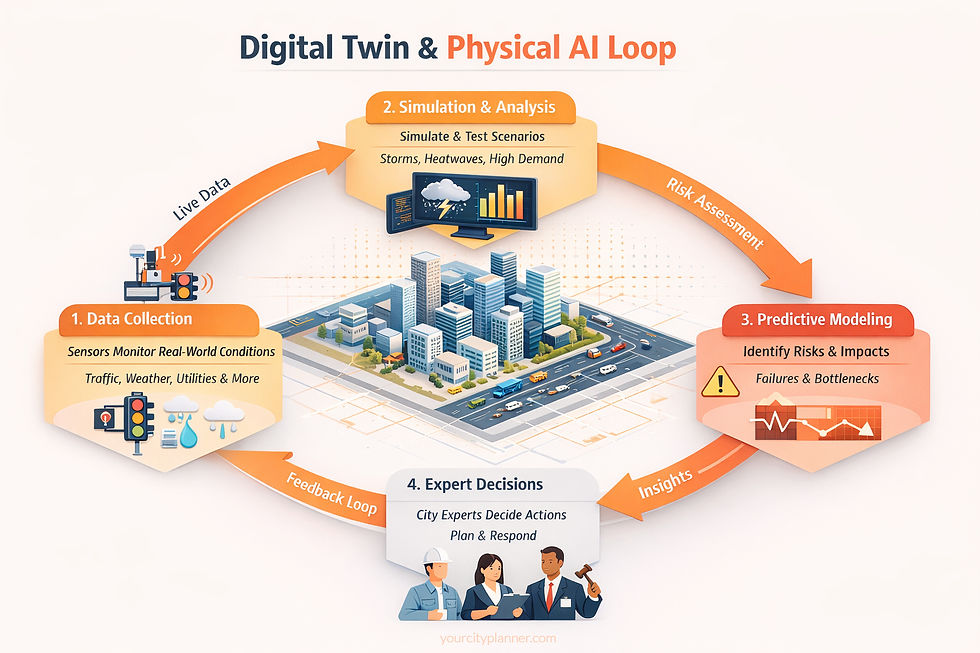
In practice, the loop looks like this:

  • Sensors capture real-world conditions like traffic volumes, flood levels, weather shifts, energy demand, and infrastructure stress. In cities, these sensors are typically embedded in traffic signals, utility systems, flood monitors, weather stations, building management systems, and other public assets.

  • Simulation platforms model scenarios using that live data, testing how systems respond to storms, heat waves, construction activity, or sudden surges in demand.

  • Predictive models surface risks and trade-offs, identifying where failures, bottlenecks, or cascading impacts are most likely.

  • City experts interpret the results and decide how to act.


Infographic showing a circular “Digital Twin and Physical AI Loop” around a central city illustration. Step one shows sensors in traffic lights, utilities, and weather systems collecting real-world data. Step two shows simulation platforms testing scenarios like storms and high demand. Step three highlights predictive models identifying risks and bottlenecks. Step four shows city experts interpreting results and deciding how to act, completing a continuous feedback loop.

That final step is essential. Cities are not closed systems. Data can reveal pressure points, but it cannot resolve competing priorities around equity versus efficiency, speed versus safety, innovation versus public trust. That work still belongs to engineers, planners, emergency managers, and elected officials.


The city remains decisional. The AI remains advisory. Not because the technology is weak, but because the environment is irreducibly complex.


The digital twin does not replace planning departments or emergency managers. It gives them a constrained environment where hypotheses can be tested, blind spots exposed, and consequences examined before reality absorbs the cost.


The City as a Constraint System

What makes cities valuable to AI developers is not just data, it is friction.


Zoning codes, environmental regulations, safety requirements, political boundaries, and public accountability impose limits that no private lab can replicate. These constraints force emerging technologies to confront reality early, while changes are still cheap and assumptions still malleable.


In a mature digital twin environment, future mobility companies could evaluate proposed air routes against noise ordinances, safety corridors, and neighborhood impact long before seeking regulatory approval. Infrastructure or logistics firms could test how new concepts interact with pedestrian density, curb access, or emergency response needs without placing equipment on the street.


These are not deployments.

They are rehearsals.


The value lies in allowing innovation to collide with civic reality before the public does.


From Infrastructure to Compute: Cities as AI Platforms

Miami’s Brickell Digital Twin is not a pilot program, nor a procurement exercise. It is a layered partnership.


At the foundation, the city partnered with NVIDIA and Dell to establish the physical AI infrastructure: the compute capacity, simulation environment, and digital backbone required to model complex urban systems at scale. That layer is not experimental. It is enabling.


On top of that foundation, Miami is inviting other companies to test their own compute and model-layer technologies within the Brickell digital twin. These range from climate analytics and mobility modeling to infrastructure forecasting and risk simulation.


This distinction matters. Miami is not shopping for finished products. It is offering a city as a reference environment, where emerging technologies can be tested against real urban constraints without immediate deployment.


In effect, the city is acting as a platform host.


For participating companies, this provides something difficult to replicate elsewhere: access to high-quality infrastructure, real-time urban data, and a credible public setting in which models can be evaluated before they ever touch the street. For the city, it avoids vendor lock-in while allowing multiple technical approaches to be tested side by side.


Miami has created a structured on-ramp for companies that want to understand how their systems behave in a dense, climate-exposed, economically active urban core while keeping humans firmly in charge of interpretation and decision-making.


From Control to Leverage

Concerns about cities “losing control” to private AI misunderstand how cities already operate.


Municipal governments have long depended on private actors for infrastructure—from power and water to telecommunications and transportation. AI does not introduce dependency. It makes dependency visible.


The more meaningful question is whether cities gain leverage in return.


By positioning itself as a reference environment for validation, Miami becomes valuable to technology companies. That value creates influence over standards, transparency, accountability, and the pace at which innovations move from simulation to street.


Dependency, in this model, runs both ways.


The Real Innovation: Institutional Confidence

Miami’s real innovation is not technical sophistication. It is institutional confidence with the ability to say, We don’t need to invent this technology to govern it.


That confidence attracts capital. In the first half of 2025, nearly $830 million flowed into AI startups in the Miami metro area. Investors are responding not just to talent or ambition, but to a city that understands how innovation actually matures: through constraint, credibility, and contact with reality.


Physical AI does not become trustworthy by staying abstract. Cities do not become irrelevant by opening their doors.


The future of AI will not be decided by who trains the largest model or controls the most data. It will be decided by who is willing to let intelligence be tested, interpreted, and disciplined in public.


Miami is betting that cities are not obstacles to AI’s future, but rather its proving ground.

Interested in writing, speaking, or advisory collaborations?

Thanks for reaching out!

copyright © 2026 | Your City Planner | all rights reserved  

www.yourcityplanner.com

bottom of page